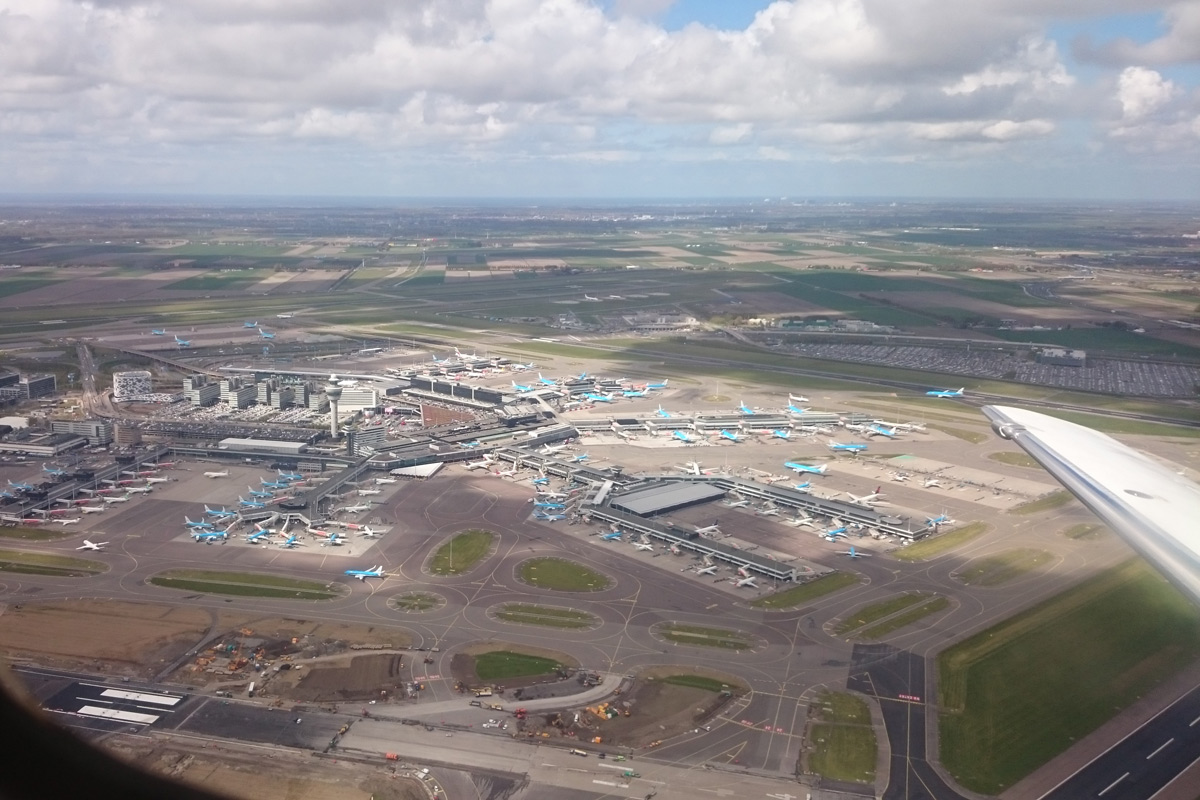
Amsterdam Airport Schiphol is the Netherlands’ main international airport and one of the most important aviation gateways in Europe. For private jet travel, Schiphol offers a combination that is not always easy to find: the infrastructure and reliability of a major international airport, together with dedicated business aviation handling in a separate part of the airfield. For passengers travelling to Amsterdam, the Randstad or other parts of the Netherlands, this makes Schiphol a practical and well-connected option for private aviation.
Geographically, Schiphol is very well positioned. The airport lies just outside Amsterdam and has direct access to the Dutch motorway network, making transfers by chauffeur efficient to the city, the Zuidas business district, The Hague, Rotterdam, Utrecht and beyond. Rail access is equally strong. Schiphol Airport station is located directly beneath the terminal complex, and trains run frequently between Schiphol and Amsterdam Central, with a journey time of around 17 minutes. For international and domestic travellers alike, that level of ground accessibility is one of Schiphol’s strongest advantages.
For private jet passengers, the key business aviation area is Schiphol-Oost. Schiphol’s General Aviation Terminal is located alongside the platform where private jets take off and land, creating a more separate and discreet environment than the main commercial passenger terminals. This part of the airport supports private and business aviation movements with dedicated facilities and a more controlled arrival and departure process. That is particularly valuable for corporate travellers, family offices, senior executives and private clients who place a premium on privacy, efficiency and direct handling.
Jet Aviation operates the FBO at Amsterdam Airport Schiphol from the General Aviation Terminal at Schiphol-Oost. According to the operator, the Amsterdam FBO provides passenger handling, on-site immigration and customs clearance, transportation, hotel and catering coordination, refuelling, de-icing and aircraft cleaning. The facility also offers two executive lounges, two crew lounges, crew workstations and weather and flight planning support. In practical terms, this gives operators and passengers a full-service private aviation setup within the wider framework of one of Europe’s busiest airports.
From an operational point of view, Schiphol has extensive runway infrastructure. The airport has six runways in total. The longest is the Polderbaan at 3,800 metres, while the Kaagbaan, Buitenveldertbaan, Aalsmeerbaan and Zwanenburgbaan all exceed 3,000 metres in length. In addition to these, Schiphol also has the Schiphol-Oostbaan, which is shorter at slightly over 2,000 metres and is used mainly for General Aviation, private jets and helicopters. This is particularly relevant for business aviation, because it means Schiphol has a runway that is specifically associated with smaller private aircraft, while still retaining access to much longer runways where operationally required.
That runway profile allows Schiphol to accommodate a broad range of private aircraft types. For shorter sectors and efficient regional flying, turboprops and smaller business jets can be well suited to the airport environment, including aircraft such as the Pilatus PC-12, Beechcraft King Air, Cessna Citation CJ series and Embraer Phenom 300. For larger European missions, aircraft such as the Cessna Citation XLS, Learjet 75 and Challenger 350 are also natural fits. Where longer-range capability is needed, Schiphol’s larger runways can support super-midsize and long-range aircraft including the Falcon 2000, Gulfstream G450 or G650 and Bombardier Global series, always subject to payload, weather, slot availability and the operator’s performance calculations on the day.
One of Schiphol’s strengths is that it combines this runway flexibility with the resilience of a major hub airport. For clients, that often means a dependable operating environment, experienced ground support and strong onward travel options once on the ground. At the same time, the presence of a separate General Aviation Terminal helps avoid much of the standard commercial passenger flow. The result is an airport that remains highly practical for private aviation, while still offering the depth of services associated with a large international field.
There are, however, a few planning considerations that are worth understanding. Schiphol-Oostbaan is mainly used for General Aviation and private jets, but it is not used overnight under Schiphol’s standard night-time runway arrangements. In addition, Schiphol is a very busy airport, so private jet movements must always be planned carefully within the broader operational environment of the airport. In practice, this does not reduce Schiphol’s appeal for private aviation, but it does make professional flight planning and well-organised ground handling particularly important.
Overall, Amsterdam Airport Schiphol is a strong choice for private jet travel to the Netherlands. It offers direct access to Amsterdam and the wider Randstad, a dedicated business aviation area at Schiphol-Oost, an established FBO with executive and crew facilities, and runway infrastructure suitable for almost every mainstream category of business aircraft. For many private jet itineraries, that combination of location, facilities and operational capability makes Schiphol one of the most practical airports in the region.
If you are planning a private jet flight to or from Amsterdam Airport Schiphol, the most suitable aircraft will depend on the route, number of passengers, baggage profile and the level of cabin comfort required. JetServiceNL will be pleased to advise on the most suitable options for your itinerary.
Office
JetServiceNL BV · Member of JSNL Group BV
Winthontlaan 200
3526KV UTRECHT
The Netherlands
Company registration: 65493257
VAT number: NL856134624B01
Contact
T: +31 85 303 1474



JetServiceNL BV is member of:

© 2026 - JetServiceNL BV, The Netherlands
|
|
Services
Ad-hoc private charters
Group charters
Medical flights
Broker desk
Jet card & participation
Aircraft managment and leasing