
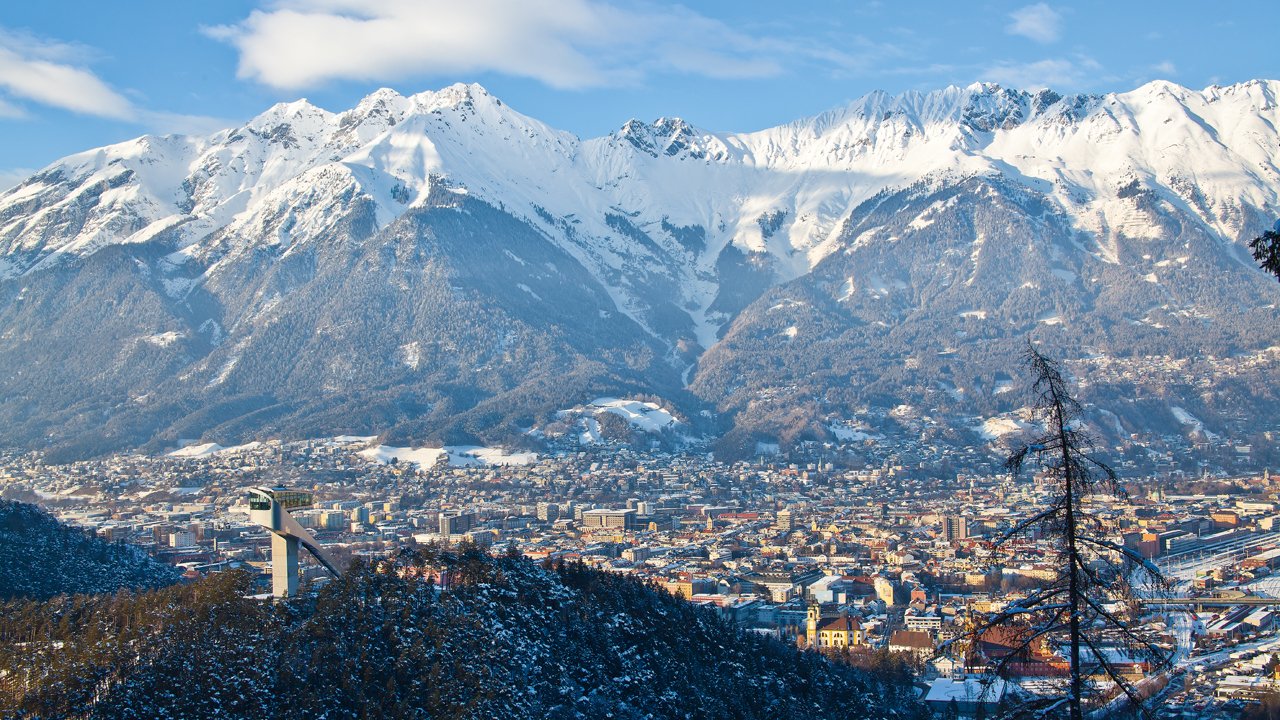
Innsbruck Airport: landing directly in the heart of Tyrol
Innsbruck Airport (INN / LOWI) sits on the western side of the city, around five kilometres from the centre. The airport has its own General Aviation Center for private jets, business jets and air-taxi traffic. That makes Innsbruck useful for a short business trip as well as a ski weekend: after landing, there is no long transfer from Munich or Salzburg before the journey into Tyrol even begins.
The runway is 2,000 metres long. That works well for many turboprops and light business jets, but runway length does not tell the whole story at Innsbruck. The airport lies in an Alpine valley and uses specific arrival and departure procedures. Wind, visibility, temperature and surrounding terrain therefore play a greater role than at an airport on flat terrain.
When preparing a charter quotation, we consequently look beyond the aircraft type and also consider the operator and crew that will actually perform the flight. An aircraft may have more than enough range and seats yet still be a weaker choice if the combination of performance, forecast weather or operational preparation is less suitable. For passengers, the result remains simple: we shortlist options that have been properly assessed for an Innsbruck operation.
The short distance to the city is a major advantage. A lunch meeting or overnight stay in Innsbruck can be planned very efficiently, while the same airport is a logical gateway to Seefeld, the Stubai Valley and destinations farther into Tyrol.
Winter weekends require earlier planning
Innsbruck publishes normal general-aviation operating hours of 06:30 to 20:00 local time. Certain qualifying commercial flights can land later, but a late-evening movement needs proper advance assessment; a departure late at night should certainly not be assumed to be available.
Winter brings an important parking rule as well. From Thursday evening through Sunday evening, the airport states that general-aviation aircraft may not remain parked for more than 60 minutes. In practice, a jet taking you to Tyrol on Saturday will normally not wait beside the terminal for the entire weekend. It will reposition after drop-off and return for the homebound sector, or the operator will arrange a different aircraft rotation.
Slots are also required on Saturdays and Sundays during the winter season. Popular ski weekends are therefore more capacity-sensitive than a Tuesday in March or a summer weekend. Booking early can help not only with finding a well-positioned aircraft, but also with securing a useful airport time.
Snow and de-icing are part of winter planning too. An aircraft departing in the morning after overnight snowfall may require additional ground time. We account for those factors in the schedule while keeping the passenger information practical: weather or airport rules only need to become part of the conversation when they can materially affect timing, feasibility or price.
Turboprop or Light Jet, with enough room for skis
At roughly ninety minutes from Amsterdam, Innsbruck is a route where both a modern turboprop and a Light Jet can work very well. A turboprop often delivers strong short-sector performance and can be financially attractive. A Light Jet is faster and quieter in the cabin and may feel more natural when comfort and journey time carry more weight.
In winter, baggage can decide the aircraft category. Skis, boots, helmets and bulky winter bags consume far more space than luggage for an overnight business trip. The published number of passenger seats therefore tells only part of the story. For four or six skiers bringing their own equipment, an aircraft with a larger or more accessible baggage compartment can be far more useful than another model with the same seating capacity.
For larger groups we can compare roomier categories, but heavier does not automatically mean better. Innsbruck performance, weather and suitable operator availability remain part of the decision. We therefore start with the actual trip: passenger numbers, baggage, requested arrival time and final destination. Only then do we decide which cabin category fits best.
If weather temporarily makes Innsbruck a weak option, alternatives such as Salzburg or Munich can become relevant. The road transfer is longer and clearly less attractive for many journeys, but it is useful to understand the fallback in advance when a chalet booking, event or business meeting cannot easily be moved.
From Innsbruck to the city, Seefeld and the Tyrolean Alps
For a city stay, Innsbruck is exceptionally compact. The Old Town, Golden Roof, Imperial Palace and Nordkette sit close together, and the airport is only a short drive away. Hotels such as The Penz and aDLERS work well for a short break or business overnight. For dinner, Oniriq is included in the current Michelin Guide, while Das Schindler offers an easy central option in the Old Town.
For skiing, the value lies in geography. Seefeld and the Stubai Valley are relatively close. The transfer becomes longer towards the Ötztal and Sölden, but Innsbruck remains the most direct aviation gateway for many addresses. Kitzbühel changes the equation and Salzburg can sometimes produce a better total journey time. We therefore look at the exact hotel or chalet rather than simply the resort name.
Innsbruck also works very well outside winter. Hiking, mountain biking, golf and business travel into Tyrol create a broad summer season. Parking and slot pressure are normally different from peak ski weekends, while the short distance between airport and city remains exactly the same advantage.
When requesting a quotation, share not only the date and passenger count but also the hotel, chalet or ski area and whether you are bringing your own skis. We can then assess aircraft, airport planning and ground transfer as one journey. At Innsbruck, that usually adds more value than simply selecting the largest or fastest aircraft.