
Velana is the main gateway, but usually not the final destination
Velana International Airport (MLE / VRMM) on Hulhulé is the primary international gateway. The current official AIP publishes a 3,400 × 60 metre runway and permits international, non-scheduled and private traffic. For a long-range business jet, handling, parking, entry, fuel planning and the resort connection are therefore often more important than runway length itself.
Maldives Airports Company describes Velana as the principal gateway and publishes the 3,400-metre runway alongside Noovilu, the major seaplane hub. VIP travel can also use Maamahi in a separate CIP/VIP building with services including fast-track and private check-in. The handler and operator confirm which facilities will be used for each charter.
MLE is not automatically the only option for every resort. The Maldivian AIP also classifies Maafaru (VRDA) and Gan (VRMG) for international, private and non-scheduled traffic. We examine an alternative only when aircraft, entry, handling, fuel, operating hours and the resort transfer genuinely work better.
The resort transfer determines your real arrival time
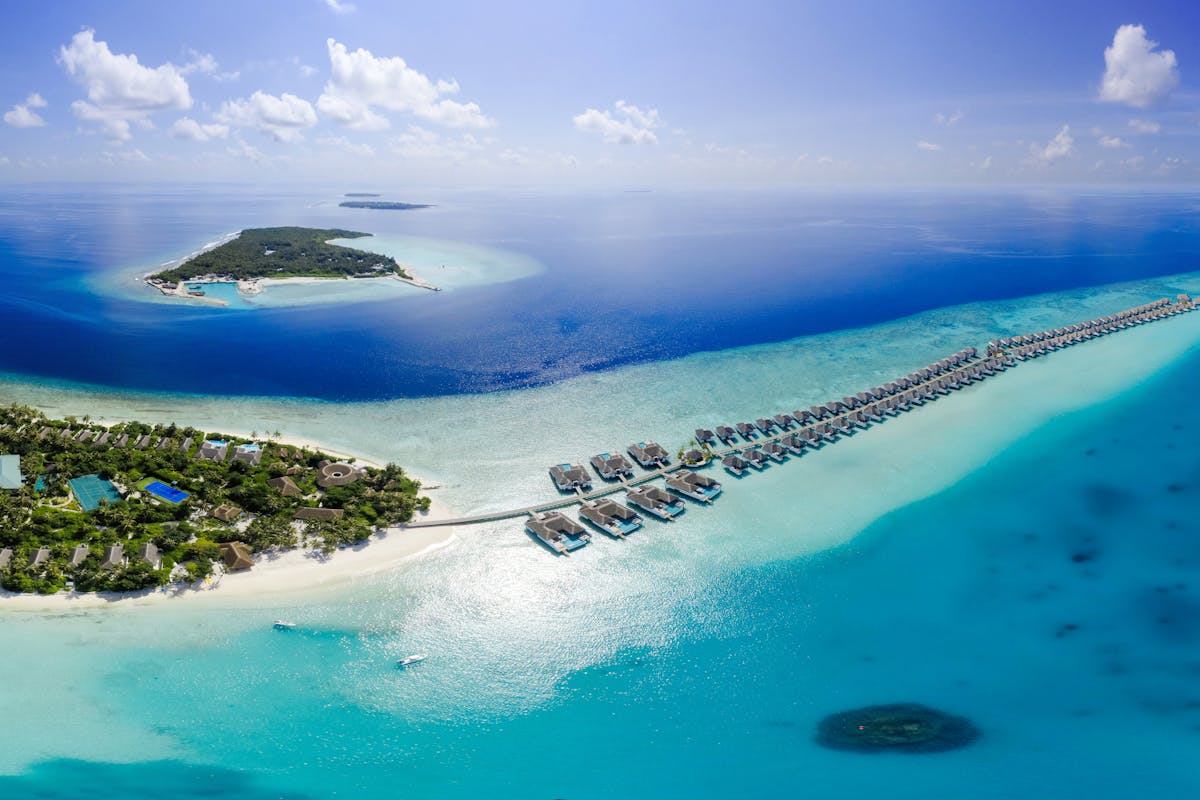
Many islands can only be reached from Malé by seaplane, domestic flight with a boat connection or speedboat. Trans Maldivian Airways serves more than eighty resorts and, through partner resorts, offers dedicated seaplane charters as well as shared transfers.
Daylight is the key limitation. TMA confirms that seaplanes operate only between sunrise and sunset and advises arrival in the Maldives by around 15:30 local time for a same-day resort connection. A delayed private jet can therefore mean that the final leg is not possible until the following morning.
We ask for the resort name before finalising aircraft choice. North Malé, Noonu, Baa, Dhaalu and the southern atolls all create different connections. We match the long-range arrival with the resort transfer and allow useful margin for immigration, baggage and terminal movement.
Long-range baggage and seaplane baggage are not the same
The capacity of a Heavy or Ultra Long Range Jet does not automatically carry over to the seaplane. TMA publishes 25 kg per passenger: 20 kg of checked baggage and 5 kg of hand baggage. Any individual bag may weigh no more than 32 kg. Excess is charged separately and baggage can occasionally follow on a later flight.
This matters for families, dive equipment and generous long-range baggage. TMA also states that surfboards and other oversized items may not fit on a shared transfer; dedicated charter can be required for such equipment. We therefore discuss baggage early with the resort and transfer provider.
For Amsterdam–Malé we compare Heavy and Ultra Long Range Jets on range, cabin, sleeping comfort, baggage volume, payload and positioning. Suitable aircraft can operate non-stop, but wind, payload, reserves or aircraft positioning can make a fuel stop more sensible. The operating AOC carrier completes the final performance planning.
We plan Malé and the island as one journey
For a useful quote we need the travel date, passengers, baggage, resort name, preferred island-arrival time and return plan. This lets us place charter routing, permits and handling alongside the resort transfer from the start.
The return journey must connect as well. TMA states that it serves guests whose international departure is after 09:00. A very early private-jet departure from MLE can therefore conflict with a resort reached only by seaplane. Sometimes a later long-range departure is smarter; sometimes another transfer or an overnight arrangement works better.
Cost is also more than eleven hours of flight time. Aircraft positioning, crew duty, any fuel stop, handling, crew overnight, parking and the resort transfer can all affect the total. A good quote therefore does not end on Velana’s apron; it explains how and when you actually reach the villa.