
Private jet to London Luton: 24/7 business aviation with dedicated FBOs
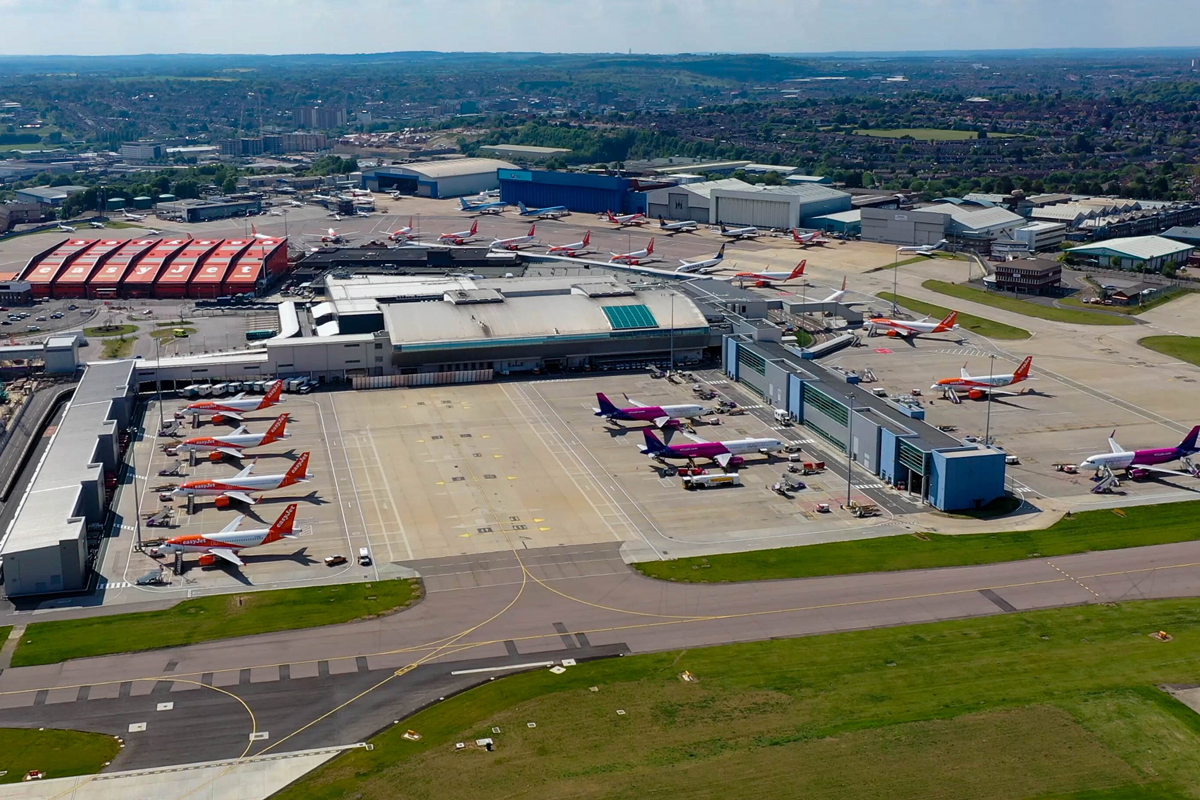
London Luton Airport (LTN / EGGW) is approximately 30 miles north of central London. It is not a dedicated private-jet airport like Farnborough, yet business aviation has a mature infrastructure of its own. The airport lists Signature Flight Support and Harrods Aviation as specialist FBO providers. Passengers therefore avoid the scheduled-airline terminal and use a separate environment with private lounges, security and direct aircraft handling.
The runway is 2.16 kilometres long and supports a broad range of business aircraft. Harrods Aviation lists capability up to Boeing 767 size at its Luton facility, while Signature Luton operates 24 hours a day, seven days a week. This makes the airport suitable for short European sectors as well as large intercontinental business jets.
The most important operational nuance is that 24-hour opening does not mean unrestricted availability. London Luton is a Level 3 coordinated airport, so every normal fixed-wing operation requires an airport slot in advance. General and business-aviation slot requests are normally managed through the handling agent. In practice, we check slot, parking stand and handling together before confirming the flight.
Night operations are also subject to noise controls and available quota. An FBO can therefore be open 24/7 while a specific late arrival or departure is still more difficult to accommodate. Harrods additionally notes seasonal restrictions during the summer period. For a flight returning after dinner in London around midnight, we therefore verify the actual operating window rather than relying solely on terminal opening hours.
Choosing the right aircraft for Amsterdam – Luton
Amsterdam – Luton is a very short sector of approximately 190 nautical miles. For two to four passengers, a Light Jet is usually the best balance of speed, cabin comfort and price. A Citation CJ2/CJ3, Phenom 300 or similar aircraft can operate the route efficiently and works well for a same-day corporate return.
A turboprop can also be economically attractive when price matters more than the modest difference in flight time. Travellers wanting more cabin height, additional baggage capacity or space for six to eight passengers may prefer a Super Light or Midsize Jet. Luton itself is rarely the limiting factor; aircraft selection is driven mainly by comfort, availability and the wider mission.
For intercontinental travel, Luton is useful because Heavy and Ultra Long Range Jets are well supported. A Global, Gulfstream or Falcon can therefore start a long sector directly from Luton.
On the short sector from the Netherlands, aircraft positioning remains decisive. A jet already based at Amsterdam, Rotterdam, Eindhoven or elsewhere in the Benelux can be much more economical than an aircraft that must first fly empty into the region. We therefore compare several categories where useful, but focus on the total mission price and confirmed slot and handling availability at Luton.
From Luton to London: choose by destination area, not airport name alone
Luton is particularly logical for North London, parts of West and Central London and Hertfordshire. The airport is around 30 miles from central London, but road transfer time varies considerably with traffic. In quiet periods the journey can be efficient; during morning or evening rush hour the same distance can take substantially longer. For a fixed-time meeting, we prefer to build in realistic margin rather than promise a theoretical minimum transfer.
Luton is particularly convenient for St Albans, Harpenden, Watford and northern sections of the M25. For Mayfair, Knightsbridge, Chelsea or Surrey, Farnborough or Biggin Hill may sometimes be faster door to door; London City can suit the City or Canary Wharf.
We therefore do not compare London airports purely on landing charges. A cheaper airport can become less efficient if the chauffeur spends an extra hour on the road, while a premium airport may save valuable time. Luton’s strength is the combination of broad operating hours, large-aircraft capability and multiple professional FBOs, but the destination area remains a key part of the decision.
For hotels, restaurants or events, we arrange the chauffeur around the FBO arrival time. Major London events increase both road traffic and business-aviation demand, making early booking useful for aircraft, slot and parking.
Slots, night operations and charter pricing at Luton
At Luton, the airport slot is a fundamental part of the operation. Airport Coordination Limited classifies LTN as Level 3 and requires operators to hold an allocated slot before operating. An arrival slot must be confirmed before the aircraft departs its point of origin. For ad-hoc business aviation, these requests are normally channelled through Signature or Harrods Aviation.
The slot regime is most noticeable on busy summer dates and at night. The airport is formally open 24/7, but noise quotas and late-night or early-morning restrictions can limit space for ad-hoc movements. A 22:00 return is therefore operationally different from a 01:00 departure. When timing is critical, we check slot availability before presenting an aircraft as a firm option.
The charter price combines aircraft type, positioning, around one hour of flight time, FBO handling, airport charges and crew planning. Luton is not always the cheapest London airport, but 24-hour infrastructure, professional FBOs and broad aircraft acceptance can justify the higher cost.
If the destination area is already known, you may share it later or include it voluntarily for more tailored airport and transfer advice. We can then compare Luton fairly with Farnborough, Biggin Hill, London City and other London airports. The aim is not to choose the best-known airport automatically, but the combination that produces the most efficient complete journey.