
Dijon-Bourgogne: business aviation without a detour via Lyon or Paris
Dijon-Bourgogne Airport (DIJ / LFSD) lies south-east of Dijon around Longvic and Ouges. Main runway 17/35 is 2,400 metres long and 45 metres wide, providing useful operating margins for many common business jets. The airfield supports IFR and VFR operations and is now clearly focused on business aviation. For travellers heading to Dijon or the northern Côte d’Or, it avoids the long chauffeur transfer associated with arriving through Lyon, Geneva or Paris.
The airport publishes normal opening from 09:00 to 18:00, seven days a week including public holidays. ATS can be opened outside those hours, but Dijon publishes a 24-hour PPR requirement for such operations. That is an important difference from a true H24 airport: an early wine itinerary or a late business return may be possible, but it needs to be part of the flight planning in advance.
FBO support is provided through the partnership between EDEIS and the ExecuJet FBO network. Services include private VIP lounges, concierge support, catering, fuel, flight planning, aircraft parking and crew assistance. A customised welcome outside normal hours can also be arranged on request. For the passenger, Dijon therefore keeps the advantages of a compact regional airport while still offering a business-aviation handling environment.
Which aircraft suits Amsterdam – Dijon?
For a flight from the Netherlands, a Light Jet is usually the first logical category. The sector is short enough for a Citation CJ, Phenom 100, HondaJet or comparable aircraft, while the 2,400-metre runway also gives room for larger business jets when passenger count, luggage or an onward route requires it. A Super Light Jet can be attractive for additional cabin comfort or a group staying several days in Burgundy.
Because runway performance in Dijon is less restrictive for many aircraft than at smaller regional airfields, the comparison quickly shifts towards aircraft availability and the total mission cost. An aircraft already positioned close to the departure point may be better value than a larger or smaller jet that first needs a substantial empty sector. JetServiceNL therefore compares current AOC aircraft around Amsterdam, Rotterdam, Eindhoven, Brussels and other practical departure airports.
Dijon, the Route des Grands Crus and a stay in Burgundy
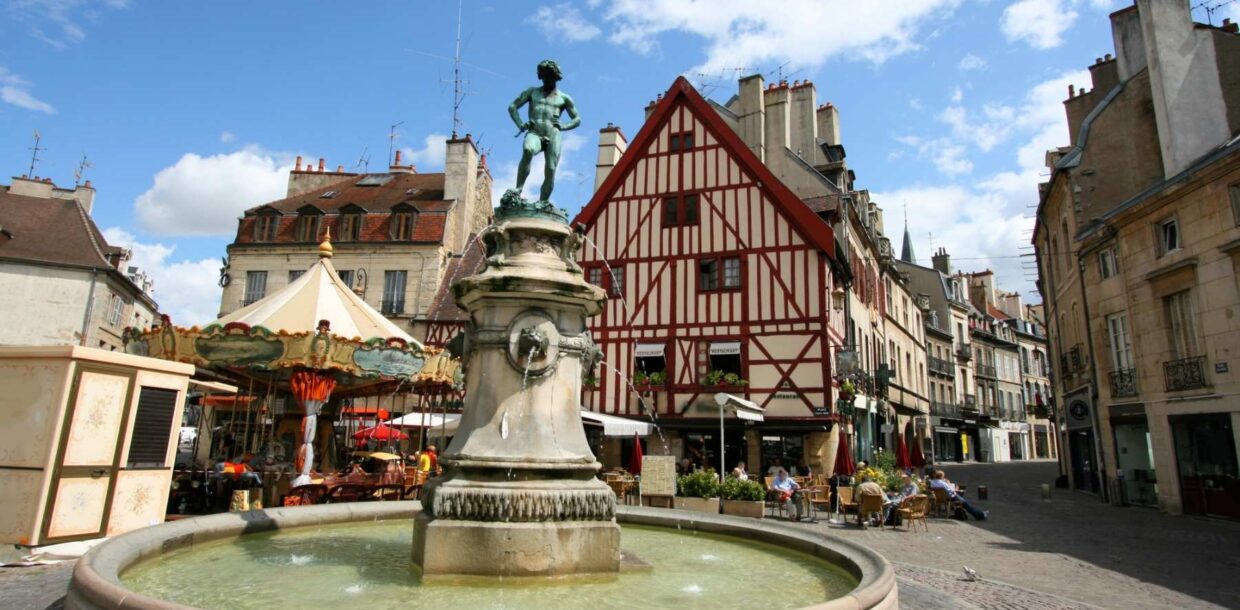
Dijon itself combines regional business activity with a compact historic centre and a strong gastronomic identity. The airport sits on the south-eastern side of the city, allowing a chauffeur to head quickly towards the centre or continue directly towards the vineyards. DIJ is therefore efficient for meetings in Dijon and equally useful for leisure journeys to Gevrey-Chambertin, Nuits-Saint-Georges, Beaune or an estate along the Côte de Nuits.
In the city centre, Grand Hôtel La Cloche is a logical five-star option. The hotel overlooks Place Darcy and combines a historic setting with a spa, restaurant and its own wine boutique. For fine dining, Hostellerie du Chapeau Rouge with chef William Frachot is another established high-end choice. Travellers focused mainly on wine may instead choose to leave the airport and drive south immediately, staying closer to the vineyards.
Opening hours, PPR and the charter price to Dijon
The normal 09:00–18:00 opening is the main scheduling point at Dijon. Outside those hours the airport publishes a 24-hour PPR requirement. An early Monday morning or late Sunday evening movement should therefore not be assumed automatically. We have the operator and FBO confirm ATS, handling, fire cover and any other required services for the requested time before the flight is committed.
The charter price is built from aircraft type, positioning, flight time, handling, any out-of-hours charges, crew planning and the chosen return structure. JetServiceNL compares those elements as one mission. A nearby Light Jet making a same-day return can therefore be more attractive than a lower headline rate attached to additional empty sectors.