
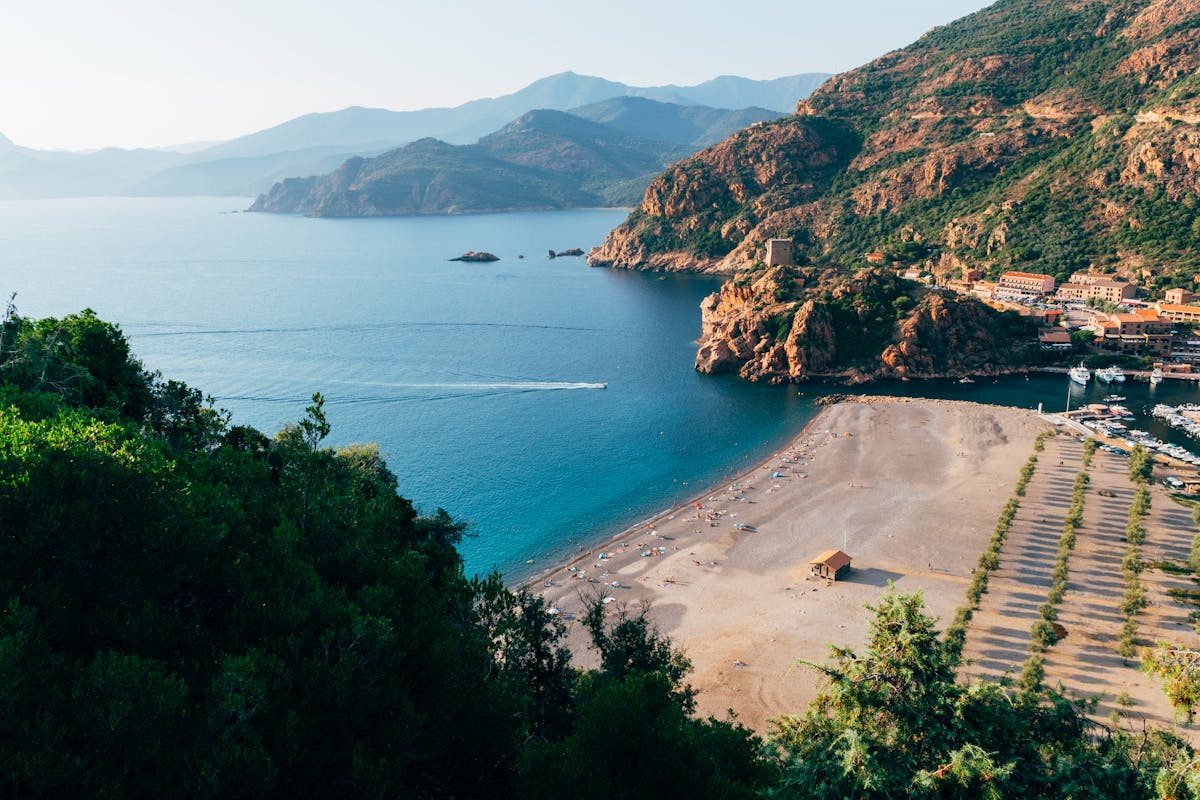
Calvi as the reference airport, with four useful airports across Corsica
Calvi-Sainte-Catherine Airport (CLY / LFKC) is the reference airport for this destination page. It is around 8 kilometres south-east of Calvi and has a paved runway measuring 2,310 by 45 metres. The published landing distance on runway 36 is 2,110 metres. That is suitable for many Light and Super Light Jets, while terrain, wind and runway condition remain part of the operator’s performance assessment.
Calvi is not the right airport for the entire island. Corsica has four international airports. Ajaccio mainly serves the west and south-west, Bastia the north and north-east, Calvi the Balagne and Figari the far south around Porto-Vecchio and Bonifacio. Mountain roads can make road journeys much longer than the map suggests, so we always ask for the actual villa, hotel or marina address before quoting the trip.
At Calvi, ground handling is mandatory year-round for general and business aviation. PPR is also mandatory: 72 hours’ prior notice is published in winter and 24 hours in the IATA summer season. Handling is broadly sunrise to sunset and ATS runs until shortly after sunset, so very late arrivals are not routine. Customs and immigration have seasonal schedules and may require advance notice.
Choosing the right aircraft for a private flight to Corsica
From the Netherlands, a Light Jet is normally a strong first choice. The route makes a jet’s speed useful and remains comfortably within non-stop range for a Citation CJ series, Phenom 300 or comparable aircraft. A Super Light Jet can be attractive for a larger party, more luggage or additional cabin comfort.
Baggage matters more than many travellers expect. A summer stay often means several suitcases plus beach, diving, golf or sailing equipment. An aircraft may have enough seats but still lack the hold volume for the planned luggage. We therefore check the actual baggage compartment before proposing a specific aircraft.
The four Corsican airports also differ operationally. Figari has a 2,480-metre runway, but during the summer aviation season it is a coordinated airport and every IFR flight requires a prior airport slot. Bastia publishes 48-hour PPR for general and business aviation. The choice is not purely geographic; timing, parking and airport conditions can influence which field is most practical.
Calvi and the Balagne, or Figari for southern Corsica
Calvi is especially strong for the Balagne: Calvi itself, L’Île-Rousse and villas or hotels along the north-west coast. The airport is close to town, allowing a quick transfer to a hotel, villa or marina after landing. For a trip centred on Calvi, using Ajaccio or Bastia normally makes little sense if Calvi is operationally available.
For Porto-Vecchio, Bonifacio, Palombaggia and Santa Giulia, Figari-Sud Corse is usually much better positioned. Corsica’s official tourism organisation also uses Figari as the arrival airport for Porto-Vecchio itineraries. That is why we never treat ‘Corsica’ as a single-airport destination. Saving a few minutes or a small amount on the flight can be lost many times over in a long road transfer across the island.
Summer demand, PPR and charter pricing
July and August are the clear peak months in Corsica. Scheduled traffic, holiday charters and business aviation compete for slots, parking and handling. Figari is coordinated during the summer season and Calvi does not offer unrestricted late-night operation. Once a villa, yacht or hotel is fixed, it therefore makes sense to coordinate the flight early as well.
The charter price depends on aircraft type, positioning, flight time, handling, airport charges and the return structure. A Calvi operation can be priced differently from Figari or Ajaccio even when the distance from the Netherlands is similar. For a one-week stay, drop-and-go may be more efficient than a week of parking; for a short weekend, keeping the same aircraft available can be simpler.
For every live request we recheck NOTAMs, handling, customs and any required slots. We then compare AOC-operated aircraft that fit the passengers, baggage and destination area. The result is not a generic ‘Corsica quote’, but a route designed around the part of the island the traveller actually wants to reach.