
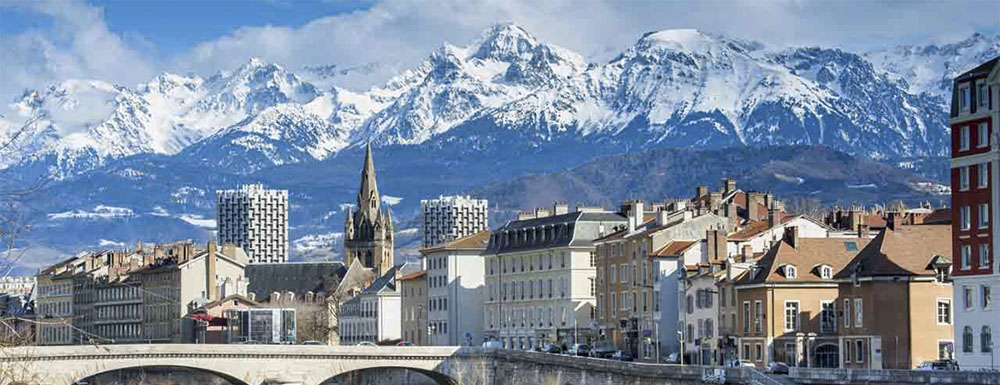
Chambéry: direct access to the French Alps
For a ski trip to the French Alps, the main advantage of private aviation is often not the time in the air but the time saved after landing. Chambéry Savoie Mont Blanc Airport (CMF / LFLB) sits much closer to large parts of the Savoie than Geneva or Lyon and can remove a substantial road transfer. Indicative block time from Amsterdam is around one hour and thirty minutes. For Courchevel, Méribel, La Tania, Les Menuires and Val Thorens, Chambéry is therefore one of the first airports we consider.
The airport has a paved runway of approximately 2,020 metres and dedicated business-aviation facilities. In winter, Chambéry becomes a genuine private-jet gateway for the Alps; the airport describes itself as one of France’s busiest business-aviation airports during the winter season. That brings valuable experience with ski traffic, but it also means popular Saturday changeover dates, February school-holiday weeks and festive periods can become busy. Booking early helps with aircraft availability, parking and preferred arrival times.
Chambéry itself can be the final destination for Aix-les-Bains and Lac du Bourget, although most of our requests continue into the mountains. We therefore assess the airport together with the actual chalet or hotel. An airport that looks twenty minutes closer on a map may still be less attractive if handling, weather or road traffic does not fit the itinerary.
Mountain weather matters more than runway length alone
Chambéry is not an extreme short-runway airport, but it is still a mountain operation. The airport publishes a runway length of around 2,020 metres and a category C classification. For passengers, the practical implication is that aircraft selection cannot be based only on seats and distance. The operating AOC carrier must evaluate current wind, visibility, runway condition, temperature and the crew’s relevant airport experience or qualification.
For Amsterdam – Chambéry, a Light or Super Light Jet is normally a strong first choice. Citation CJ-family aircraft, a Phenom 300 or a similar category combine speed with useful cabin comfort for a ski weekend. A modern turboprop can also make sense when price, baggage or operational margins matter more than the last few minutes of flight time. With a larger group or extensive ski equipment, we compare a roomier cabin, but a larger aircraft is not automatically the better aircraft in a mountain environment.
Seasonality also matters. The business terminal has broad daily opening during the winter, while outside the ski season more services operate on request. Chambéry is therefore particularly useful when the Savoie is busiest, but late schedule changes still need to be reconfirmed. If weather deteriorates or the selected operator cannot accept Chambéry, Geneva, Lyon and, depending on the final resort, Grenoble are practical alternatives.
From the apron to Courchevel, Méribel or Val Thorens
The real value of Chambéry appears on the road. For Courchevel and Méribel, the transfer heads directly towards the Tarentaise rather than first working around Lake Geneva and major international traffic. On a quiet day that is convenient; on a winter changeover day the difference can become much more meaningful. We therefore advise realistic margin between landing and a lunch reservation, chalet check-in or ski-school appointment because snow, traffic controls and road congestion can change the transfer significantly.
For a classic luxury stay in Courchevel, Le K2 Palace, Cheval Blanc Courchevel and Les Airelles remain well-known choices. Méribel has a softer chalet atmosphere with hotels such as Le Coucou. Gastronomy is a major part of Courchevel’s appeal, with restaurants including Le Farçon and the dining rooms of the palace hotels. For private chalets, we often plan the flight around check-in, chef arrival, grocery delivery and ski-equipment logistics rather than treating the flight as a separate part of the trip.
Chambéry is not only a winter airport. Lac du Bourget, cycling, hiking and corporate retreats create a different type of demand in spring and summer. Aviation traffic is generally calmer, but because the business terminal operates more on request outside the winter season, we confirm handling and opening before presenting the airport as the final option.
The best charter is not automatically the largest jet
Our price comparison follows the same category as the operational recommendation. For Chambéry, that normally means a Light or Super Light Jet. Final charter cost is driven by live aircraft position, flying time, winter demand, handling, parking and crew planning. An aircraft already positioned in Amsterdam, Rotterdam, Eindhoven or Belgium can therefore be better value than a lower hourly rate on an aircraft that first needs to position empty from southern Germany.
For ski flights we also ask for the real baggage profile. Six passengers with six large suitcases, skis and ski boots create a very different mission from six executives travelling with hand luggage. On some light jets, baggage volume becomes the limiting factor; a Super Light Jet can then be the stronger overall solution without moving straight to a midsize aircraft.
When our Destination Pricing snapshot contains enough comparable historical data, the page may show a current indication that matches this aircraft category. It remains an indication rather than a fixed charter fare. For the actual flight, we compare available certified operators and reconfirm airport acceptance, crew, weather and timing. The objective is simple: make Chambéry not just a fast flight into France, but an efficient door-to-door route into the Alps.