
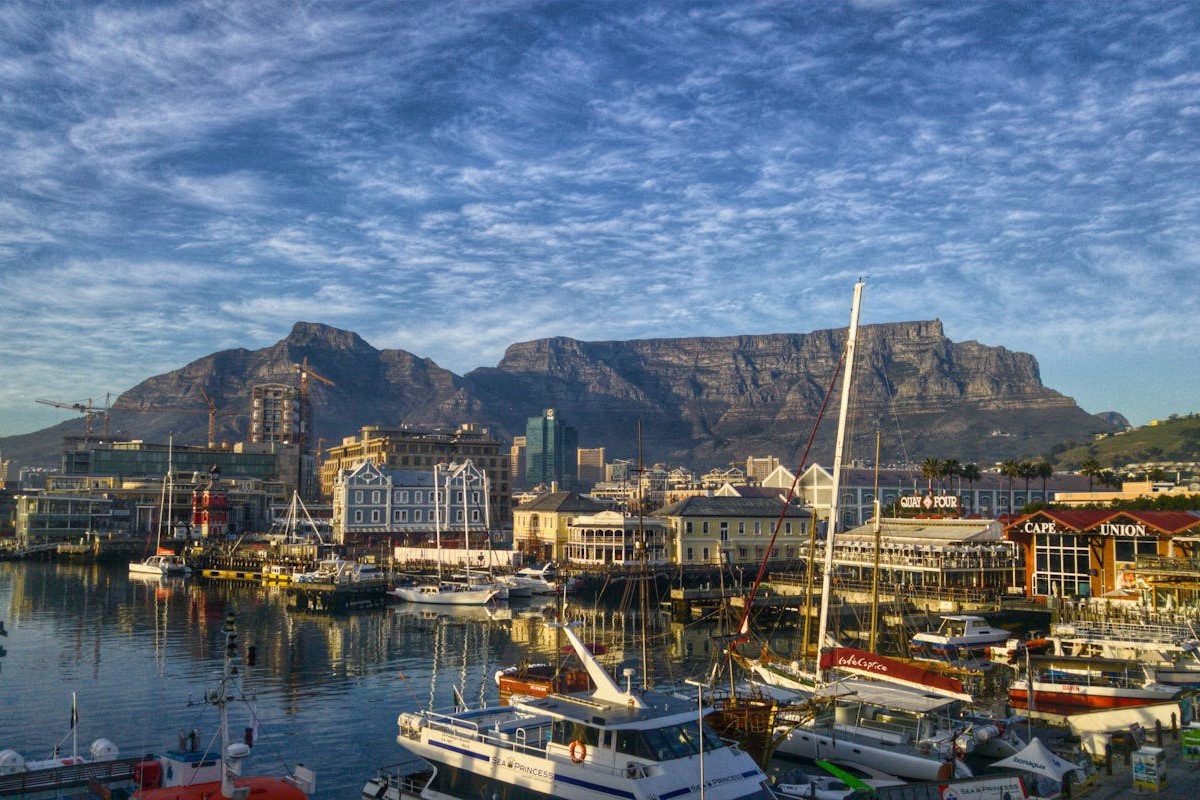
Direct to Cape Town International
For a private flight to Cape Town, Cape Town International Airport (CPT / FACT) is the logical primary airport. It is a major international gateway with the runway length and infrastructure required for heavy long-range aircraft. Airports Company South Africa also positions Cape Town International as an important tourist and VIP destination. For a direct charter from Amsterdam there is therefore rarely a reason to force a more distant airport into the plan.
The indicative block time from Amsterdam is around thirteen hours. This makes Cape Town a true long-haul mission where the chosen arrival time matters. An overnight flight can work well when the cabin is genuinely suitable for sleeping; a daytime sector may suit passengers who prefer to work in flight and arrive locally in the evening. Together with the operator, we review the routing and departure time that best fit the itinerary.
Cape Town is known for wind, and in the warmer months the strong south-easter can become part of the operating picture. That does not make private aviation problematic, but it does mean that dispatch and current weather remain important. Parking and handling are also checked for each mission, particularly around Christmas and New Year, major international events and peak periods in the South African summer season.
When the arrival connects directly to a villa, yacht charter or safari transfer, we also build margin into the schedule after landing. A one-hour delay is relatively harmless on a free afternoon, but much more relevant when a helicopter, lodge transfer or fixed lunch reservation follows the flight.
A long-range cabin designed for a thirteen-hour flight
For Amsterdam – Cape Town, we normally recommend a heavy or ultra long range jet. On a thirteen-hour sector, passenger count is only one part of the decision. Sleeping positions, cabin altitude, noise levels, galley capability, catering and baggage volume all matter. Travellers going directly into meetings or continuing to a lodge after arrival gain far more from a properly equipped cabin than from an aircraft that merely has enough theoretical range.
For two to four passengers, an ultra long range jet may appear large on paper, but the additional cabin length allows the flight to be divided into separate zones for work, dining and sleep. Families and larger groups may also carry golf, surf, safari or extended-stay luggage. We therefore consider the real load plan before recommending an aircraft rather than relying on seat count alone.
Positioning has a major influence on the charter price. A heavy jet already based in Amsterdam, Paris, London or elsewhere in Western Europe may be more attractive than a cheaper aircraft that first needs to reposition from Southern Europe. On a return trip with several days on the ground, we also consider whether the aircraft remains in Cape Town, departs empty and comes back later, or continues on another rotation. This can have more impact than moving one aircraft category up or down.
Waterfront, Camps Bay, Constantia and the Winelands
Cape Town is remarkably varied within a relatively compact area. The V&A Waterfront, City Bowl, Camps Bay and Bantry Bay are popular bases for a first visit. Mount Nelson, A Belmond Hotel, One&Only Cape Town, The Silo and Ellerman House each offer a different style: classic gardens, Waterfront convenience, design or high privacy above the Atlantic coast.
Travellers prioritising peace and wine over the city centre can consider Constantia. Stellenbosch and Franschhoek are further away but work very well as a separate part of the itinerary. For a long weekend, two nights in Cape Town followed by time in the Winelands can be a natural sequence. Passengers going directly to Franschhoek after landing should instead allow extra ground-transfer time from the airport.
The restaurant scene is a major part of the destination. FYN, La Colombe and PIER are established names for a longer dinner, while Camps Bay and the Waterfront offer more relaxed options with views. Advance reservations are sensible during the busy summer season. Local peak season broadly runs from December through March, opposite the European winter. It is excellent for outdoor travel, but also brings stronger hotel demand, more private-jet movements and sometimes tighter aircraft parking.
What determines the charter price to Cape Town?
The total price is driven mainly by the available heavy or ultra long range jet, positioning to the departure point, crew arrangement, parking and length of stay. On a long-haul return, crew accommodation and whether the aircraft remains locally can have a significant effect. A one-way mission can sometimes become attractive when an operator can connect it to an existing aircraft rotation.
Destination Pricing on the website reads only from the separate pre-built snapshot. An indication therefore appears only when enough recent comparable data exists for the same category. For Cape Town, a live quotation remains important: we compare actual aircraft, cabin layout, non-stop performance and the complete routing before presenting the final charter price.