
Caen-Carpiquet: a compact gateway into Normandy
Caen-Carpiquet Airport (CFR / LFRK) is around 7 kilometres west of Caen and is normally the most practical airport for the city itself. Its paved main runway is 1,900 metres long and 45 metres wide. The airport also publishes Jet A1 availability, dedicated business-aviation services and a VIP lounge with direct access to the apron. For a short private flight from the Netherlands, that gives a much more direct arrival than routing through a major Paris airport.
Private flights and other non-scheduled movements require PPR at Caen-Carpiquet. The airport publishes a minimum 24-hour application period, and approval only becomes valid once a PPR number has been issued. This matters on a short business trip: having an aircraft available is not sufficient on its own; the airport movement also needs to be coordinated in advance.
Published airport hours are Monday to Friday 06:00–22:00, Saturday 07:00–20:00 and Sunday 07:30–22:00. That works well for most private-jet schedules, but a late Saturday return needs different planning. International or customs-relevant flights also require the applicable information to be submitted in advance. JetServiceNL coordinates those formalities through the operator and handler, rather than leaving the passenger to deal with operational paperwork.
Which aircraft suits a private flight to Caen?
From the Netherlands, Caen is a short sector. Turboprops and Light Jets are therefore usually the most relevant categories. A King Air or similar turboprop can be commercially attractive when its cabin and travel time suit the mission; a Citation CJ, Phenom 100 or comparable Light Jet provides greater speed and jet comfort. A larger aircraft may make sense for additional baggage or passengers, but bigger is not automatically better on this route.
The 1,900-metre runway provides useful capability for many common business jets, but runway length is never the only performance factor. Temperature, wind, runway condition, take-off weight and the exact aircraft performance data all matter. The operating AOC carrier therefore confirms final aircraft performance for the planned day rather than relying on a generic aircraft-category assumption.
From Caen to Bayeux, the coast and a Normandy stay
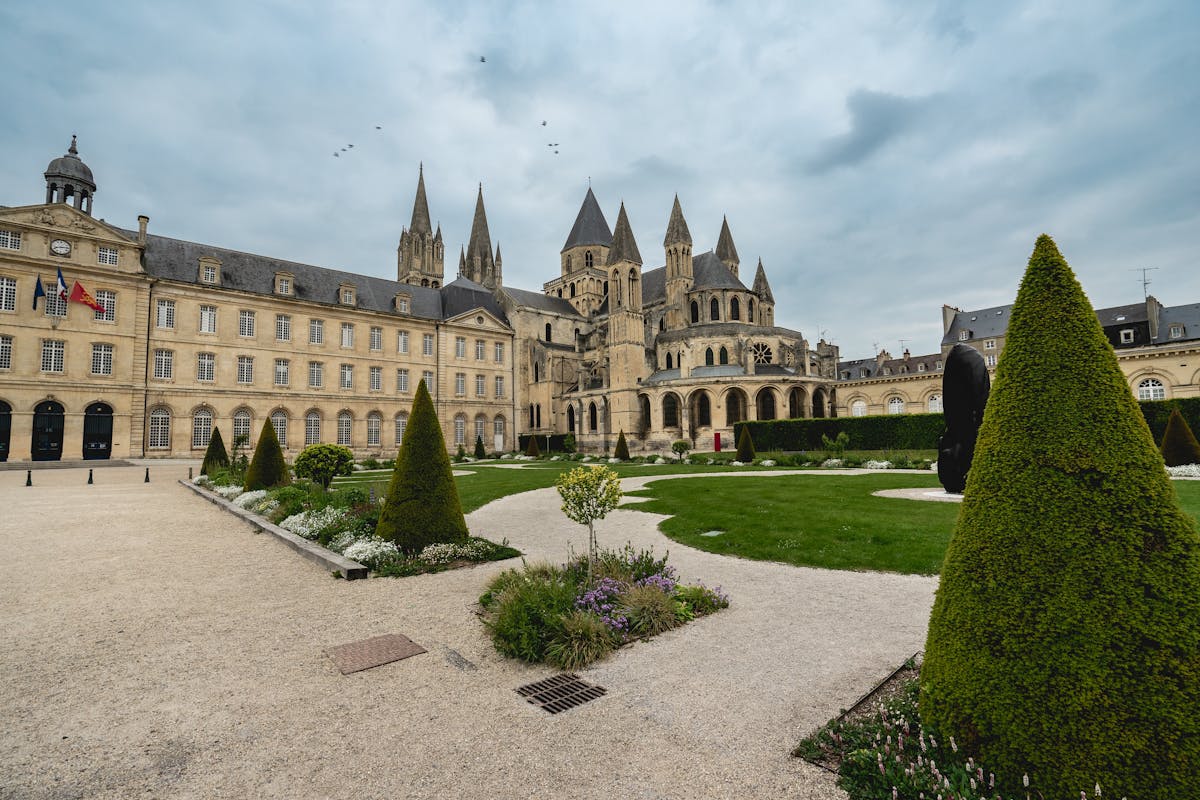
The airport is close enough to Caen for a chauffeur to take passengers directly to a meeting, hotel or restaurant in the centre. For many leisure trips, however, the true destination lies further west. Bayeux, the D-Day beaches and the coast around Arromanches and Omaha Beach are all natural extensions of a flight into Caen-Carpiquet and make the airport a useful starting point for a short Normandy itinerary.
For a stay outside the city, Château d’Audrieu fits the private-jet journey particularly well. The five-star château lies between Caen and Bayeux in the Normandy countryside and close to the Landing Beaches. Its large park, discreet setting and gastronomic restaurant Le Séran create a natural transition from a private arrival to a quieter stay without first travelling into a major city.
Travellers heading mainly to Deauville, Honfleur or the Côte Fleurie should not automatically use Caen. Deauville-Normandie can be better positioned for those addresses. For Caen, Bayeux and the central D-Day coast, Carpiquet is generally the more logical option. JetServiceNL therefore compares not only airport fees but the complete door-to-door time to the final hotel, château, company or event.
PPR, timing and the final charter price
The practical rule for Caen is simple: plan the airport at the same time as the aircraft. The published minimum 24-hour PPR period makes a well-prepared flight straightforward, but it limits true last-minute improvisation. Around D-Day commemorations, summer weekends and major regional events, requesting early is sensible mainly to preserve aircraft, parking and chauffeur options.
The charter price consists of more than the roughly one-hour airborne sector. Aircraft positioning, airport and handling charges, crew planning, possible waiting time and the structure of the return all contribute to the quotation. On a short European route, a well-positioned Light Jet can therefore be more competitive than a smaller aircraft that has to fly a long empty sector before collecting the passengers.