
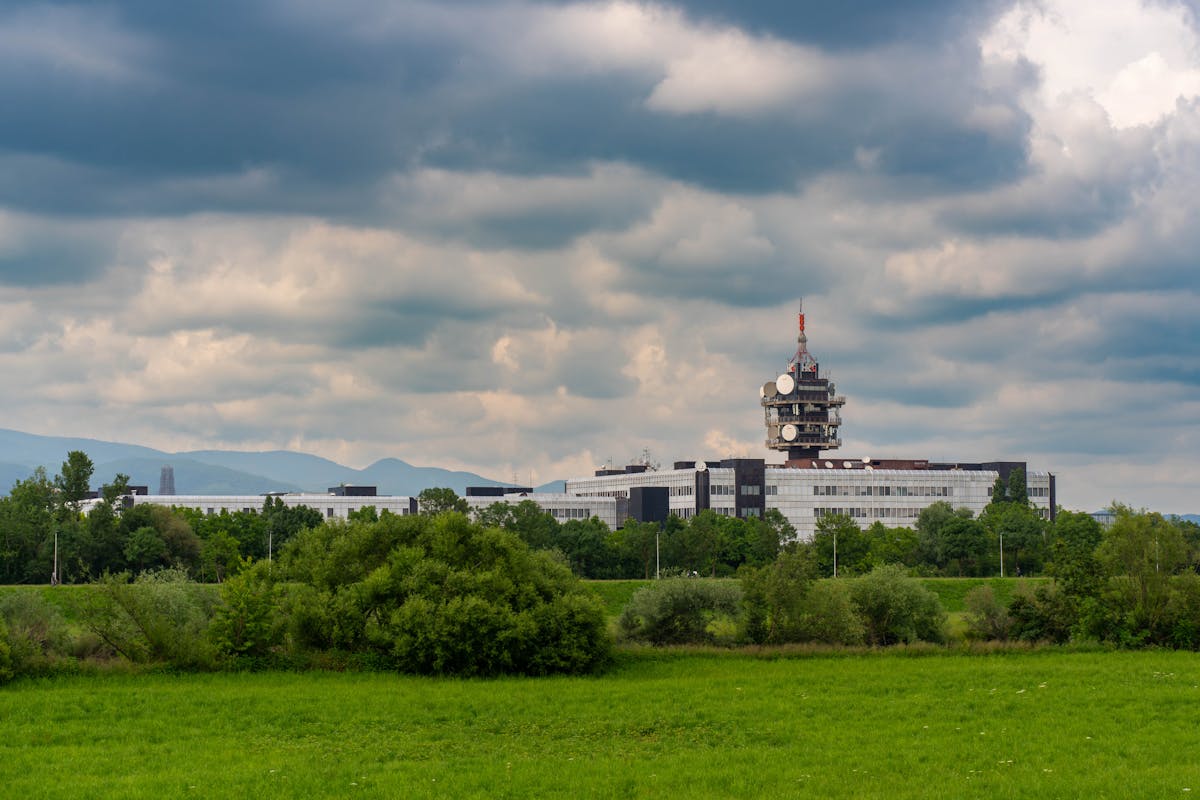
Zagreb Airport: a dedicated General Aviation Terminal close to the city
Private jet flights to the Croatian capital use Franjo Tuđman Airport Zagreb (ZAG / LDZA). The airport lies south-east of the city and has a long runway suitable for virtually all mainstream business jets. For private aviation, the dedicated General Aviation Terminal is particularly useful, allowing passengers and crew to be handled outside the normal commercial passenger flow.
The airport currently publishes General Aviation Terminal opening hours of 07:00 to 21:00, seven days a week. After 19:00, landside access to the GAT is restricted and certain handling moves through the main passenger terminal; opening the GAT outside standard hours can be requested at additional cost. This becomes relevant when a dinner is followed by a late departure.
Central Zagreb is normally straightforward to reach by road. For meetings in Lower Town, around the main railway station or at government and corporate addresses in the centre, a pre-arranged chauffeur is the simplest solution. City traffic can build during peak periods, although transfer times remain manageable compared with many larger European capitals.
ZAG also works as a gateway to northern Croatia. For Varaždin, the castles and spas of Hrvatsko Zagorje or an appointment outside the capital, driving directly from the aircraft may be more efficient than routing through a central hotel. The genuine final address is therefore useful information when planning the charter.
Light or Super Light Jet: two hours with a broad aircraft market
Amsterdam–Zagreb is a classic Light Jet mission. A Citation CJ, Phenom 300-type jet or similar aircraft can perform the sector efficiently and works well for two to six passengers. A Super Light Jet becomes attractive when additional cabin space, baggage volume or a more generous feel is preferred without moving all the way into the Midsize category.
Because Zagreb has a long runway, aircraft selection is rarely driven by runway performance. Baggage, aircraft availability and the chosen departure airport matter more. A short board meeting with two travellers may favour a compact Light Jet; six passengers with larger suitcases may be much more comfortable in a roomier aircraft.
A same-day return works well, but the requested departure time affects both GAT use and crew-duty planning. A flight after a late dinner may be perfectly possible from the airport while falling outside the standard General Aviation Terminal schedule. We therefore establish in advance whether main-terminal handling is acceptable or whether a GAT extension is preferred.
For a multi-day trip, the aircraft may reposition after arrival. This is often cheaper than keeping crew and aircraft in Zagreb, but not always: if an operator has another mission in the region, remaining nearby may be efficient. We compare the complete rotation rather than simply multiplying an hourly rate by two sectors.
Lower Town for business, Upper Town for character
For corporate travel, Lower Town is generally the easiest base. Many hotels, offices, restaurants and representative streets are close together. Esplanade Zagreb Hotel is the city’s classic grand hotel beside the main railway station. It offers several restaurants and bars, including Le Bistro Esplanade, which appears in the 2026 MICHELIN Guide Croatia.
Upper Town around St Mark’s Square is more historic and atmospheric, with narrower streets and much of Zagreb’s recognisable architecture. It is excellent for a walk or dinner, although a Lower Town hotel is often more practical for a tight meeting schedule. Distances are compact enough to combine both parts of the city without complicated logistics.
Zagreb has a relaxed restaurant culture, strong Croatian wines and a growing fine-dining scene. A hotel restaurant can make sense for a business lunch; an evening in the city is more enjoyable when time allows. If the flight leaves the same evening, we prefer a chauffeur already on standby rather than trying to arrange transport after dinner.
With more time, Zagreb can be combined with Zagorje, wine regions or a continuation to the Adriatic coast. For Split, Dubrovnik or the islands, flying onward may be more logical than spending hours on the road. A multi-city private itinerary such as Amsterdam–Zagreb–Split–Amsterdam can therefore be more efficient than forcing every movement into a simple return.
Corporate year-round, with event and December peaks
Zagreb is less seasonal than the Croatian coast. Corporate travel, government activity, conferences and regional meetings continue throughout the year. December adds leisure demand through the Christmas markets and winter atmosphere, while spring and early autumn are particularly pleasant for combining meetings with free time.
Large congresses, sporting events or political meetings can temporarily tighten hotel and chauffeur supply. The airport itself has substantially more capacity than smaller Adriatic gateways, yet private aviation still depends on aircraft and handling availability. Securing key dates early remains worthwhile.
Charter price is built from aircraft position, flight time, handling, parking and the return structure. A Super Light Jet is more spacious but is not automatically required for this sector. When the separate Destination Pricing snapshot has enough historical comparisons, the website may display an indicative range. The actual proposal is always based on the market available for your travel date.
Tell us whether you plan to return the same day, when the final appointment ends and whether use of the dedicated General Aviation Terminal is important to the experience. With that information we can compare Light and Super Light Jets properly and avoid a low headline price being undermined by inconvenient late handling.