
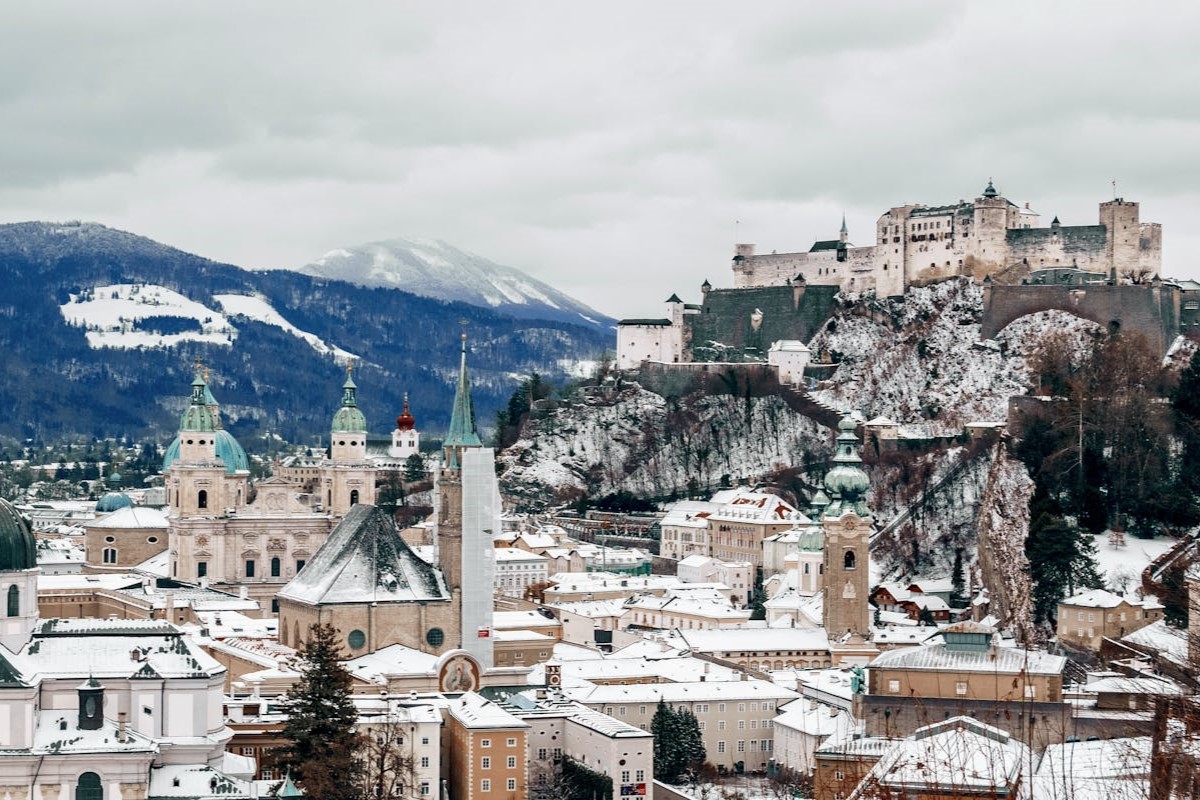
Salzburg Airport: close to the city, strategic for the Alps
Private flights use Salzburg Airport W. A. Mozart (SZG / LOWS). The airport sits directly west of the city and has a runway of roughly 2,750 metres. Salzburg Airport provides its own General Aviation handling and apron support, so business aviation is a familiar traffic stream. For a stay in Salzburg the transfer is short; for ski travel, the airport’s real value is its position relative to several major Alpine resorts.
Operating hours are an important planning point. Salzburg currently publishes a basic take-off and landing window of 06:00 to 23:00 local time, with more detailed restrictions for certain non-commercial movements and noise categories. We therefore do not assume that a very late return is automatically possible. The operator and handler confirm the actual flight profile, aircraft and current operating conditions in advance.
Winter adds snow, de-icing, visibility and peak traffic. Changeover days around Christmas, February holidays and popular ski weekends can increase pressure on parking and handling. Private aviation is particularly valuable because the departure can be built around your chalet, hotel or ski schedule, but it pays to confirm the flight earlier rather than starting the search on Friday for Saturday morning.
Turboprop or Light Jet: short sector, serious winter baggage
For Amsterdam – Salzburg a Turboprop or Light Jet is usually the most sensible first comparison. The sector is short enough for a modern turboprop to be commercially attractive, particularly for a small party. A Light Jet adds speed, a quieter cabin and often a more refined experience for a business trip or short ski weekend. Runway length itself is generous; the choice is mostly about the mission, comfort and baggage.
Ski luggage deserves specific attention. Skis, snowboards, boots and large winter cases do not automatically fit every Light Jet. We therefore check baggage-door dimensions, ski storage and the actual payload of each offered aircraft. A slightly larger Light Jet can be more practical than a cheaper aircraft that has enough passenger seats but insufficient room for equipment.
Weather is a genuine operational factor in Salzburg without making it a small mountain airfield. Its position on the northern edge of the Alps means wind, low cloud and winter precipitation can matter. The operating crew assesses procedures and minima for the actual day. For an important connection or a very short weekend, we also keep alternative airports and ground transport in mind if conditions deteriorate.
Salzburg, Kitzbühel or Saalbach: the transfer defines the real route
For a city stay, Salzburg is exceptionally straightforward. The Altstadt, Getreidegasse and the Salzach river are a short drive from the airport. Hotel Sacher Salzburg and Hotel Goldener Hirsch are classic high-end choices on different sides of the historic centre. Dinner can be traditional Austrian, or you can build an evening around Hangar-7, which sits close to the airport and fits surprisingly well into a short charter itinerary.
Many passengers land in Salzburg without sleeping in Salzburg. Kitzbühel, Saalbach-Hinterglemm, Leogang and Zell am See each require a different road transfer. Saturday traffic into the ski areas can add substantial time. Landing thirty minutes earlier may therefore be worth more than choosing a slightly faster aircraft. We align the requested touchdown with the chalet location and any fixed check-in, lunch or ski-school timing.
Salzburg works well outside winter too. The Salzkammergut lakes, golf, festivals and the city itself create strong summer demand. During the Salzburg Festival, hotels, chauffeurs and private aviation can all become busier. Travellers attending a performance should avoid planning a return departure so tightly that a late curtain call creates an operational problem.
What determines the charter price to Salzburg?
Price is driven mainly by the available Turboprop or Light Jet, positioning and the requested schedule. Because Amsterdam – Salzburg is a relatively short sector, an empty positioning leg can represent a large share of the total cost. An aircraft already in the Netherlands, Belgium or western Germany may therefore be stronger than a jet with a lower headline hourly rate but a long ferry flight.
In winter, possible de-icing, parking, crew planning and whether the aircraft can remain during your stay also matter. For a week of skiing, a drop-and-go structure is often logical; for a same-day event, keeping the aircraft may be more efficient. We compare both structures when commercially useful.
Any price indication on the website is read only from the pre-built Destination Pricing snapshot. The page does not start a live Pricing Intelligence or Flight Advisor calculation. An indication is displayed only when enough comparable data exists for the same aircraft category. Your actual proposal is always based on current availability and the operating conditions of the specific journey.