
Lynden Pindling International Airport: the practical airport choice for Nassau
Lynden Pindling International Airport (NAS / MYNN) is the first practical airport for this page. Lynden Pindling International is the central Bahamian hub and has FBO support for Corporate and General Aviation. Its long runway makes NAS the most robust destination for a heavy intercontinental arrival from Europe. The handler coordinates customs, immigration, parking, fuel and crew services for the actual movement. LPIA can see heavy GA volumes around US holiday peaks; that is a reason to confirm parking early, not to publish an unofficial universal PPR lead time.
NAS is the natural choice for New Providence or Paradise Island. Travellers continuing to Exuma or a private island can transfer by smaller aircraft, helicopter or boat; in some cases a direct international arrival at the other island is more efficient.
After landing we arrange a chauffeur to the actual final address. For Nassau, Paradise Island, New Providence, we compare road time at the requested time of day because the geographically closest airport does not always create the fastest door-to-door journey.
Choosing the right aircraft for Nassau
An intercontinental mission to Nassau requires more than theoretical range. Routing, overflight permits, winds, alternates, crew duty, fuel and payload are considered as one operating plan. Ultra-long-range capability can enable a non-stop flight, while a carefully selected technical stop can sometimes be more robust or commercially attractive. We make that comparison before presenting any aircraft as the preferred option.
From the Netherlands, Heavy or Ultra Long Range Jet is the first logical category. We then assess the specific aircraft for passenger load, baggage, winds, runway performance and whether it waits or repositions. This keeps the recommendation mission-led rather than category-led.
Intercontinental trips often involve more baggage: several cases per passenger, garment bags and sometimes sports or business equipment. Payload and hold volume can therefore affect non-stop performance. We include baggage from the start rather than treating it as an afterthought once an aircraft has been selected.
The departure point in the Netherlands or Belgium matters as well. For Nassau, an aircraft already positioned in Amsterdam, Rotterdam, Eindhoven, Brussels or another nearby European base can avoid substantial empty positioning. On long sectors we also consider whether a technical stop from a different departure airport creates an operational advantage before treating any one airport as the default.
From touchdown to meetings, hotel or leisure
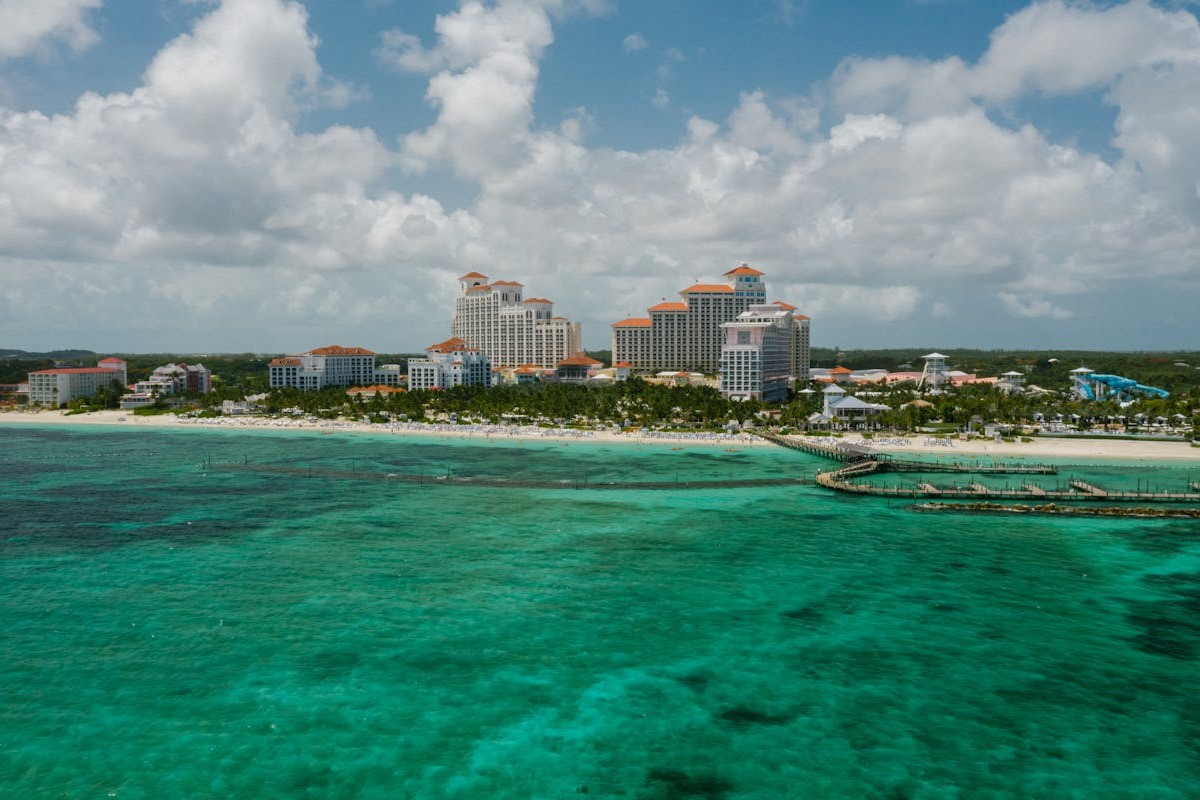
For accommodation and meetings, Paradise Island, Cable Beach, Old Fort Bay are the logical areas. Travellers often combine resorts, meetings, private clubs and yachting holidays with Atlantis, Baha Mar, yachting and private clubs. Hotel and chauffeur are kept outside the flight price, while their location still informs the airport choice. For an early meeting or late arrival, staying closer to the airport or appointment can also be more comfortable than automatically choosing the best-known city centre.
Leisure planning is more often driven by the hotel, villa, golf, yacht or a longer stay. Baggage, parking and whether the aircraft waits become more important than on a simple same-day return. For Nassau, we therefore consider the complete day: departure from home, FBO, flight, arrival, chauffeur and the time the traveller genuinely needs to be at the final destination. That is usually more valuable than pursuing the shortest airborne time alone. A same-day return also requires a different aircraft and crew plan from a stay of several nights. Waiting can be efficient for a short stop; for a longer stay we compare drop-and-go with a fresh positioning movement. This keeps aviation aligned with the traveller’s agenda rather than the other way around.
Season, schedule and charter pricing
Nassau peaks strongly around Christmas/New Year, US holidays and spring breaks. Summer and autumn are quieter but require more tropical-weather awareness; hotel, marina and FBO planning often run in parallel on high-end trips. The handler coordinates customs, immigration, parking, fuel and crew services for the actual movement. LPIA can see heavy GA volumes around US holiday peaks; that is a reason to confirm parking early, not to publish an unofficial universal PPR lead time. During a known peak, we recommend requesting early mainly to preserve aircraft and parking choice, not because we invent a universal booking deadline.
When planning Nassau, we therefore look beyond the requested departure time. We check whether the same crew can operate the rotation, how much margin is sensible for handling and the ground transfer, and whether an early or late movement is operationally practical. During events, school holidays and peak weekends, booking early mainly preserves aircraft and parking choice; we do not invent a fixed lead time where the airport has not published one.
The charter price to Nassau ultimately reflects aircraft availability, positioning, flight time, airport and handling charges, crew planning and the way the return is structured. Keeping the aircraft on the ground can be ideal for a short stay; for several days, drop-and-go or a fresh positioning flight may be more economical. A website price indication appears only when enough comparable historical data is available. For the actual trip you always receive current AOC options with total price and conditions.