
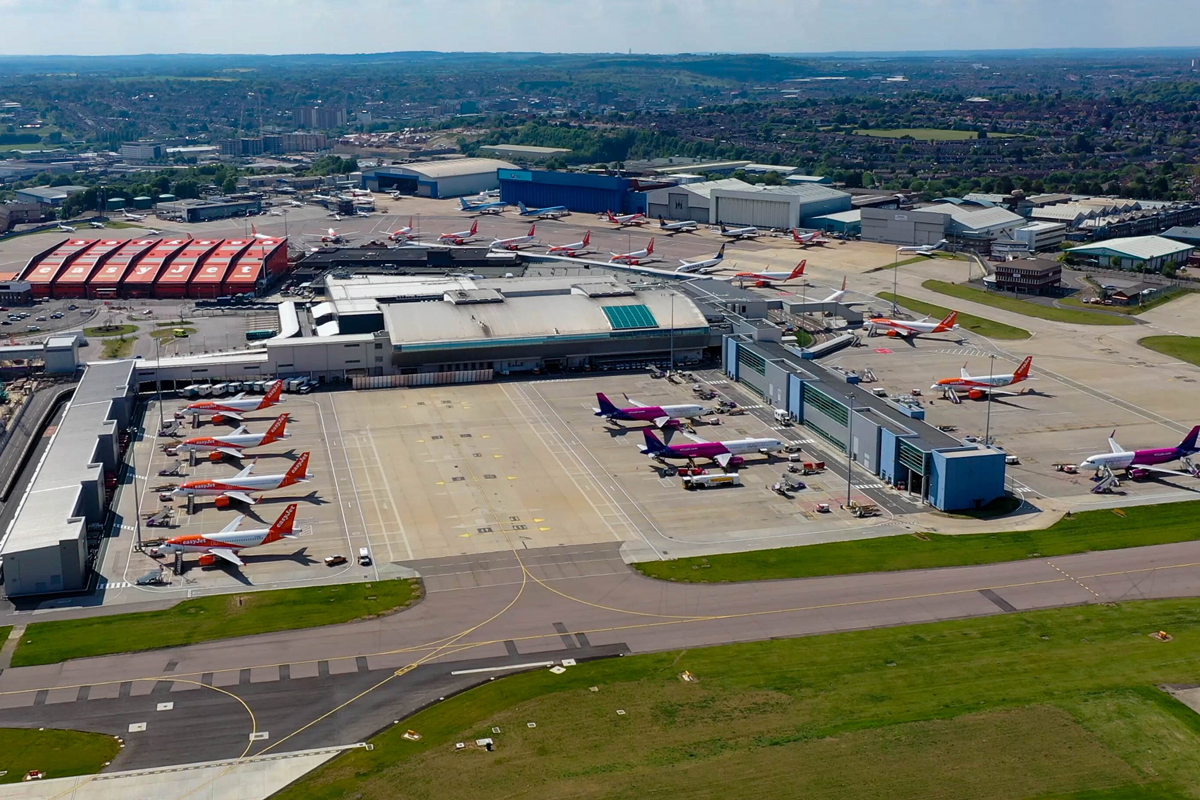
London Luton Airport: the practical airport choice for Luton
London Luton Airport (LTN / EGGW) has a dedicated business- and private-aviation environment; the airport itself lists providers including Harrods Aviation. Its roughly 2.16-kilometre runway supports a broad business-jet mix. The difference from Farnborough or Biggin Hill is that Luton is part of a busy commercial airport. We therefore check slots, parking, handler and current capacity for each movement rather than assuming business aviation always has immediate access.
Luton is not automatically the best London airport. Farnborough can be better for West London, Biggin Hill for the south and east, and Stansted for Essex or East Anglia. Luton’s strength is the combination of mature FBO infrastructure, broad aircraft capability and a location north of the city. Aircraft position can also influence price materially because many charter aircraft circulate around London.
The drive to Mayfair, Knightsbridge or the City uses a busy road network and is sensitive to peak traffic and incidents. Luton is substantially better placed for St Albans, Hertfordshire and North London. Some travellers combine the trip with a helicopter transfer, although for most European missions a pre-arranged chauffeur remains the most robust solution. We plan to the actual final address with realistic London traffic margin.
Choosing the right aircraft for Luton
On a short European sector to Luton, the time difference between aircraft categories is modest, while the economics of the complete mission can vary considerably. An aircraft already positioned near your departure point, able to carry the required baggage and able to wait efficiently may be more attractive than a larger jet with a lower-looking hourly rate. We therefore compare the complete rotation rather than the nominal flying time alone.
The airport can handle aircraft far larger than Amsterdam – London requires. Our practical first choice is normally a Light Jet or Super Light Jet, while the broader guidance extends to Heavy Jets when the onward mission or group size requires one. A compact jet may be fastest to source and commercially strongest. Cabin size, baggage and aircraft position matter more than range on the short sector.
Luton is heavily used by executive teams, family offices and international travellers connecting through London. Baggage can therefore range from laptop bags to a full long-haul luggage set. For a simple sector from the Netherlands, a compact external hold is often enough. If the aircraft continues to the US or Middle East, we assess payload for the entire multi-leg mission rather than only the first hour into London.
We also compare more than Amsterdam on the departure side. For Luton, Rotterdam, Eindhoven, Brussels or another regional airport may be closer to the traveller or to the available aircraft. On a short sector, reducing empty positioning can make a larger price difference than a few minutes of cruise-speed advantage.
From touchdown to meetings, hotel or leisure
For a city stay, Mayfair, Knightsbridge, Belgravia and Marylebone remain popular high-end areas. Luton is relatively well placed for business around King’s Cross, Euston and North London. Hotels such as Claridge’s, The Connaught and The Berkeley lie farther west and require more road margin; on a short meeting trip, staying closer to the business address can be more efficient.
London offers such a wide fine-dining market that ground planning matters more than naming one “best” restaurant. Mayfair has extensive private dining, while Soho, Marylebone, the City and Shoreditch each offer different strengths. For a late return from Luton, we prefer a restaurant that sits logically on the route to the airport rather than adding a cross-city transfer purely for a fashionable postcode.
Season, schedule and charter pricing
London has peaks throughout the year: Wimbledon, Royal Ascot, fashion weeks, football, concerts and major conferences. Luton can handle substantial business traffic during these periods, while slots and parking remain finite resources. Winter adds fog, wind and de-icing; in summer event demand is often the larger factor. We source early when the date has little flexibility.
When planning Luton, we therefore look beyond the requested departure time. We check whether the same crew can operate the rotation, how much margin is sensible for handling and the ground transfer, and whether an early or late movement is operationally practical. During events, school holidays and peak weekends, booking early mainly preserves aircraft and parking choice; we do not invent a fixed lead time where the airport has not published one.
The charter price to Luton ultimately reflects aircraft availability, positioning, flight time, airport and handling charges, crew planning and the way the return is structured. Keeping the aircraft on the ground can be ideal for a short stay; for several days, drop-and-go or a fresh positioning flight may be more economical. A website price indication appears only when enough comparable historical data is available. For the actual trip you always receive current AOC options with total price and conditions.