
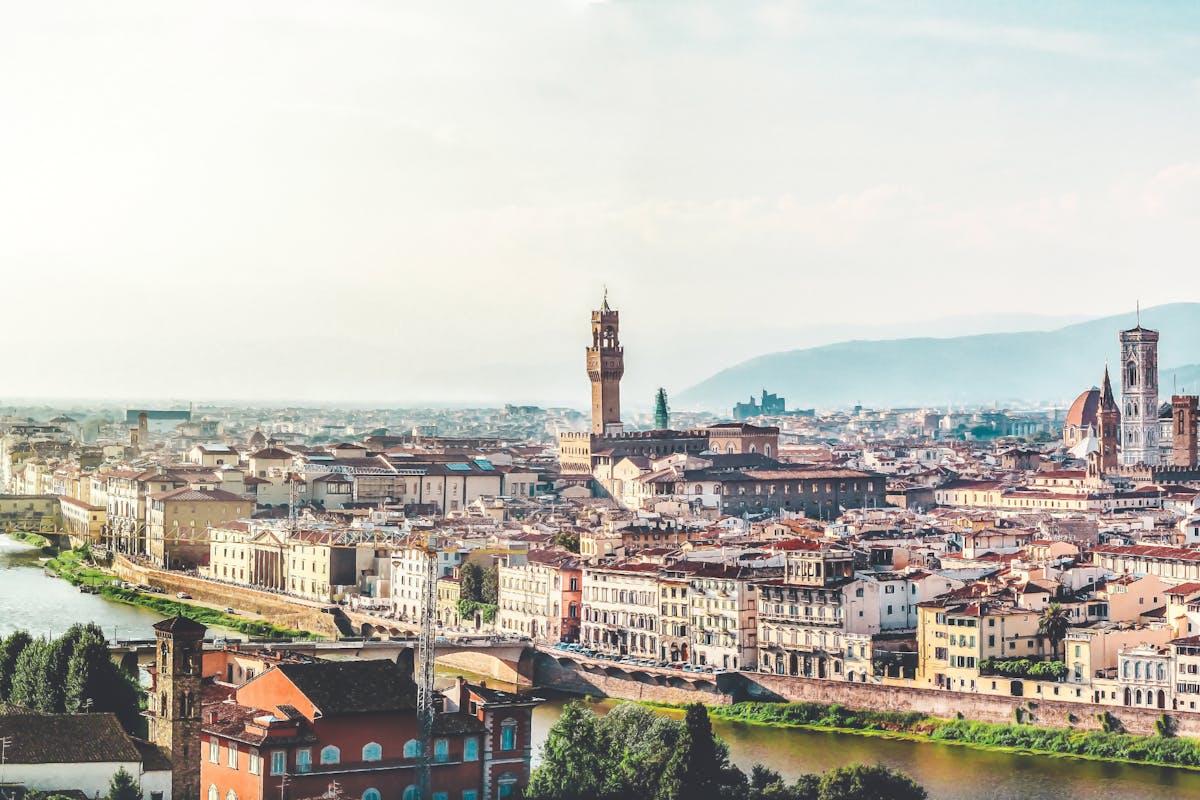
Florence Peretola or Pisa: terrain and weather drive the airport choice
Florence Airport, Peretola (FLR / LIRQ) is exceptionally close to the city and is therefore an excellent private-aviation airport. The historic centre, hotels along the Arno and many business addresses can be reached quickly after landing. Its runway, at around 1,560 metres, is shorter than at many major international airports, but this does not mean Florence is limited to turboprops or the smallest jets. Many Light and Super Light Jets are very well suited to Peretola when the actual conditions and performance calculation provide adequate margin.
The distinctive factor is the airport's position beside hilly and mountainous terrain. In normal operations this makes Florence strongly directional: arrivals are predominantly planned from one side and departures in the opposite direction. Wind can therefore have much more operational impact than at an airport where either runway direction can be used with the same terrain margins. An aircraft may be perfectly suitable in terms of runway length and still face a restriction when wind or weather becomes unfavourable. This is why we never judge Florence on runway length alone.
Pisa Galileo Galilei (PSA / LIRP) therefore remains an important alternative. Pisa is further from Florence but offers substantially more runway margin and is less affected by the same terrain constraints. If weather at Florence is questionable, the payload is high or the operator sees insufficient performance or wind margin, Pisa can be the more reliable choice. For a short meeting in central Florence, Peretola normally wins on ground time; for Chianti, Lucca, Forte dei Marmi or a wider Tuscany itinerary, Pisa can also make geographical sense.
Light or Super Light Jet: an excellent match for Florence
For Amsterdam – Florence we usually recommend a Light or Super Light Jet. A modern Super Light Jet can be particularly attractive here: it provides generous cabin comfort and baggage capacity for a European leisure or business trip without automatically bringing the extra mass and runway requirement of a larger Midsize or Heavy Jet. For two to four passengers a Light Jet may still be the most efficient choice, while five to eight passengers or a larger baggage load often fit a Super Light Jet very well.
Suitability is never determined by category alone. Weight, temperature, wind, runway condition and the performance data of the individual aircraft remain decisive. Florence is not a high-elevation airport, but warm summer days and an unfavourable wind component can still change the available margins. Because terrain makes the approach and departure direction less flexible, weather can become decisive sooner than it might at airports such as Venice or Rome. A good Florence plan therefore always includes an aircraft-specific performance check and a realistic alternate.
This also means we do not automatically move to a smaller aircraft simply because Florence is involved. If a Super Light Jet works comfortably for the actual mission, it can be the best solution for cabin comfort, baggage and price. Only when the conditions reduce the margin do we compare a different aircraft or Pisa. The recommendation is therefore based on the real mission rather than a generic assumption that a shorter runway always requires a small aircraft.
Florence itself: the centre, Chianti and where to stay
Florence is compact enough to make a short trip highly efficient. For a central high-end stay, Four Seasons Hotel Firenze and Portrait Firenze are established options with very different characters. Four Seasons feels more like an urban retreat with a large private garden, while Portrait sits directly by the Arno and suits a short visit where much of the programme can be reached on foot.
The city is equally strong for both traditional Tuscan food and fine dining. Enoteca Pinchiorri is an established choice for a long gastronomic evening, while Il Palagio at Four Seasons is convenient when hotel and dinner need to be combined seamlessly. A private-jet weekend does not need to be formal throughout, however. A good bistecca alla fiorentina, lunch around Santo Spirito or an afternoon in the countryside can provide the contrast that makes Florence so appealing.
For a stay of more than one or two nights, Florence combines naturally with Chianti, Siena or a wine estate in the hills. At that point the trip becomes a Tuscany itinerary rather than simply a city break and the Florence-versus-Pisa decision deserves another look. The city can be hot and busy in midsummer, while spring and autumn often work better for combining urban visits with the countryside. Major fashion and trade events such as Pitti Uomo can create sharp peaks in hotel and charter demand.
What determines the private jet price to Florence?
The charter price is driven first by the available Light or Super Light Jet, its positioning and whether the mission can be operated directly into Florence. A Super Light Jet is not automatically an expensive or operationally awkward choice here; for five to eight passengers it can provide an excellent balance of cabin space, baggage capacity and runway performance.
Weather can nevertheless influence both the plan and the total cost. If wind or other conditions restrict normal operations at Florence, Pisa may become the preferred alternative. That adds ground-transfer time and can sometimes change positioning or crew planning. For a business day return the same aircraft may be able to remain nearby and operate a compact round trip, while a longer stay can make repositioning more attractive.
The website does not calculate a live price on this page. Any indication is read only from the pre-built Destination Pricing snapshot and is displayed only when enough comparable data exists for the same aircraft category. A concrete quote remains especially important for Florence because aircraft type, weather and the available operational direction together determine which solution works best on the day.