
DuPage gives a long-haul private flight a calm arrival into Chicago
For a private flight from the Netherlands, DuPage Airport (DPA / KDPA) is often the first Chicago airport we consider. Located west of the city, it is strongly focused on corporate and private aviation and has a 7,571 ft primary runway. That gives useful margin for the larger aircraft normally used on a nonstop transatlantic mission. DuPage Flight Center handles private passengers and U.S. Customs is available on the airport, allowing an international charter to clear there when the arrival has been coordinated in advance.
Being outside Downtown is not a disadvantage when the ground journey is planned properly. DuPage itself describes the drive to central Chicago as roughly one hour, but traffic can create a major difference between a quiet afternoon and the morning or evening peak. For a hotel on the Chicago River, a meeting in The Loop or dinner in West Loop, we therefore schedule the car around the expected arrival rather than relying on a theoretical average transfer time.
Chicago Executive Airport (PWK) can be useful when the programme is concentrated in the northern suburbs. It has U.S. Customs and several private aviation providers, but its longest runway is 5,001 ft. That can work very well for smaller jets and domestic sectors; for a heavily loaded long-range aircraft, DuPage generally offers more room. O'Hare remains an option when a specific aircraft, connection or itinerary benefits from it, but most private passengers appreciate starting their Chicago visit through a smaller dedicated facility.
Amsterdam to Chicago is mainly a question of range, cabin comfort and westbound margin
Chicago sits considerably farther inland than New York or Boston. The route from Amsterdam is around 3,600 nautical miles and the westbound flight can encounter strong headwinds. For that reason, a Heavy Jet or Ultra Long Range Jet is usually the most sensible starting point. A small group may be very comfortable in an efficient aircraft at the lower end of those categories, while more passengers, substantial luggage or a need for separate sleeping areas can justify a larger cabin.
The aim is not to select the biggest aircraft by default. We consider passenger numbers, luggage, cabin expectations and the forecast for the day. A four-person corporate trip with hand luggage is a different mission from a family travelling in winter with extensive baggage or continuing elsewhere in the United States. The eastbound return is often helped by the prevailing winds, so the round trip should not be treated as two identical flights.
For a short stay, keeping the same aircraft in the Chicago area may be practical. On a longer programme, it can make more sense to source a suitable aircraft for the return rather than paying for one to wait for several days. Our quotation therefore compares the complete itinerary rather than reducing the trip to an hourly figure. This keeps the aircraft recommendation realistic and makes the quoted price reflect how the journey will actually be operated.
Chicago River, Gold Coast or West Loop: base the stay around the programme
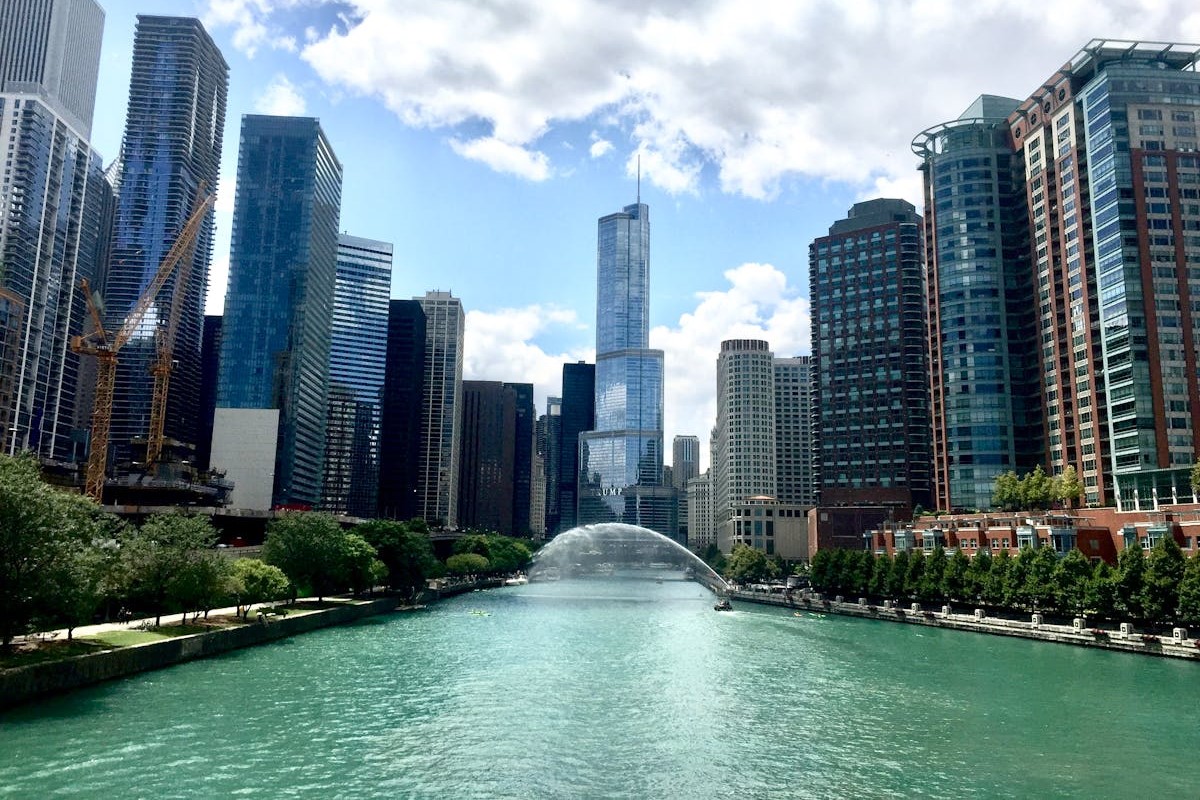
Chicago is a large city, yet many business and leisure addresses are concentrated around Downtown. River North and Gold Coast are convenient when meetings, restaurants and shopping need to sit within one compact area. The Peninsula Chicago is just off Michigan Avenue and works particularly well around the Magnificent Mile. The Langham is on the Chicago River and is well placed for The Loop, River North and the central business district.
West Loop has become an important dining and business district and is only a short drive from the river when traffic cooperates. Travellers spending more time in Lincoln Park or farther north may choose a different hotel and, in some cases, benefit from Chicago Executive Airport. Alinea, for example, is in Lincoln Park and is the kind of dinner that deserves its own space in the schedule rather than being squeezed between meetings. On a busy trip, keeping a chauffeur available can make these movements far simpler.
Conventions at McCormick Place or appointments on the South Side create another ground pattern again. This is why a destination page does not need to pretend there is one universally best hotel or a single fixed transfer time. We prefer to know where the first meeting is and where the passengers are staying. The car can then leave the airport in the right direction immediately, preserving the time advantage that justified the private flight in the first place.
Season and agenda determine how much margin Chicago needs
Chicago is a year-round business destination. Spring and autumn are pleasant for mixing meetings with time in the city, while summer brings life to Lake Michigan, the river and outdoor terraces. Winter can be very cold, with snow, ice and wind affecting both aircraft preparation and the drive into town. These are normal operating conditions for Chicago and can be planned for, but they make an itinerary with no reserve at all less sensible.
Major conventions, sports events and citywide weekends can also tighten hotel and chauffeur availability quickly. At those times, securing the ground arrangements early is often more valuable than trying to save a few minutes in the air. After a nine-hour flight, a driver who knows the private terminal and continues directly to the correct address is part of what makes the journey feel effortless.
For departure, we plan the collection time around real traffic towards the airport and the agreed flight time. DuPage then restores the advantage of a facility built around private aviation: short walking distances, a compact passenger process and no lengthy journey through a major airline terminal. With the flight and ground journey planned together, Chicago remains a very efficient private-jet destination despite the transatlantic distance.