
Bournemouth Airport: the practical airport choice for Bournemouth
Bournemouth Airport (BOH / EGHH) publishes a runway of about 2,272 metres. The airport and XLR Executive Jet Centre explicitly support corporate aviation and state that the airfield can accommodate large aircraft. For the typical Dutch sector, runway length is therefore rarely the main limitation. We focus more on requested timing, aircraft position, handling and the actual final address on the Dorset coast.
Southampton is a useful alternative for addresses farther east or around Winchester, while Farnborough can make sense for Surrey or West London. For Poole, Sandbanks, Bournemouth and much of Dorset, BOH normally has the clearest geographic logic. During busy summer weekends, parking or availability can change the comparison, so we consider multiple airports when useful.
Bournemouth town centre is close, but many private-jet travellers continue to Poole, Sandbanks, Christchurch or the New Forest. Road time varies significantly in summer when coastal traffic builds. A chauffeur meeting the flight at the executive facility is therefore worthwhile. We plan a transfer to a waterfront hotel or Sandbanks property differently from a corporate appointment in Bournemouth or a country-house stay toward Hampshire.
Choosing the right aircraft for Bournemouth
On a short European sector to Bournemouth, the time difference between aircraft categories is modest, while the economics of the complete mission can vary considerably. An aircraft already positioned near your departure point, able to carry the required baggage and able to wait efficiently may be more attractive than a larger jet with a lower-looking hourly rate. We therefore compare the complete rotation rather than the nominal flying time alone.
For Amsterdam – Bournemouth, a Light Jet or Super Light Jet is normally the strongest balance. A smaller CJ or Phenom can operate the short sector efficiently; a Super Light Jet adds baggage volume and cabin comfort for four to eight passengers. A turboprop is also viable when price matters more than speed. The long runway means the decision can focus on economics and comfort rather than being driven by runway length.
Dorset trips often have a leisure element: golf bags, beach equipment, pushchairs or several suitcases are common. For a holiday home or yacht transfer, volume can matter more than seat count. We ask about this in advance and look at the aircraft’s genuinely usable baggage compartments. This avoids choosing an attractive Light Jet that fits the passenger count on paper but not the group’s actual luggage.
From touchdown to meetings, hotel or leisure
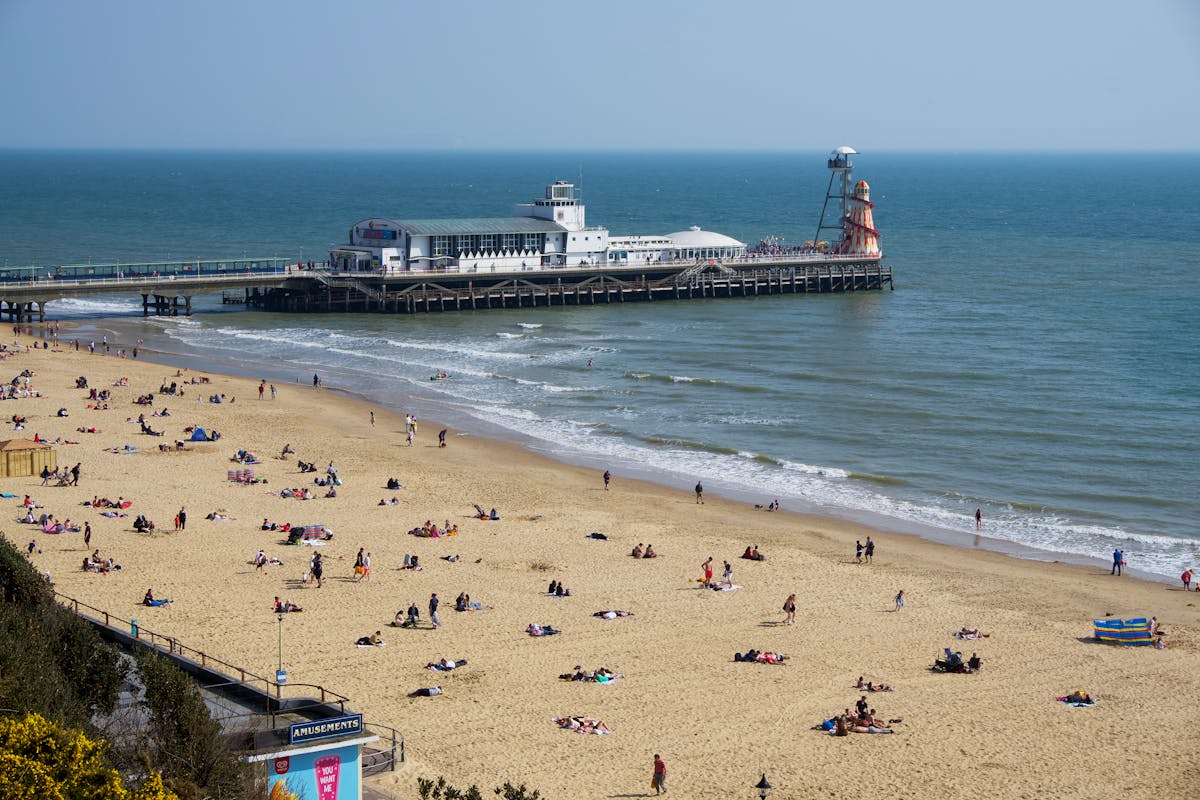
Bournemouth has wide beaches and a lively centre, while higher-end leisure demand often concentrates around Sandbanks and Poole Harbour. Country-house hotels toward the New Forest are another strong option. Coastal restaurants work well for a relaxed weekend, while Christchurch and Poole can offer a quieter dinner. For yacht or villa itineraries we connect the chauffeur directly with the marina or accommodation rather than routing through the town centre.
The New Forest is close enough to combine coast and countryside. Hotels such as Chewton Glen work well for travellers who do not need to stay in Bournemouth itself. Sandbanks and Poole are natural choices for marinas, watersports and long summer days. Corporate travellers may be better staying close to the meeting; the region looks compact on a map, but summer traffic can turn an unnecessary detour into lost time. For a late return flight, we also make sure the chauffeur schedule leaves sensible margin for security and handling.
Season, schedule and charter pricing
Bournemouth and Dorset are at their strongest from late spring to early autumn. Summer weekends create more demand for hotels, villas, chauffeurs and aircraft parking. Outside the main season the area is quieter, while wind and coastal weather can require more planning. For school holidays and bank-holiday weekends we prefer to request aircraft options early, without inventing a fixed reservation lead time where none is published.
When planning Bournemouth, we therefore look beyond the requested departure time. We check whether the same crew can operate the rotation, how much margin is sensible for handling and the ground transfer, and whether an early or late movement is operationally practical. During events, school holidays and peak weekends, booking early mainly preserves aircraft and parking choice; we do not invent a fixed lead time where the airport has not published one.
The charter price to Bournemouth ultimately reflects aircraft availability, positioning, flight time, airport and handling charges, crew planning and the way the return is structured. Keeping the aircraft on the ground can be ideal for a short stay; for several days, drop-and-go or a fresh positioning flight may be more economical. A website price indication appears only when enough comparable historical data is available. For the actual trip you always receive current AOC options with total price and conditions.