
Queen Alia: the robust gateway for Amman and Jordan
For most private-jet flights to Amman we use Queen Alia International Airport (AMM / OJAI). Located south of the capital, the airport has two long runways of approximately 3,660 metres. This makes Queen Alia suitable for virtually all common business-jet categories, from Super Light and Midsize aircraft to long-range jets. For an international charter from the Netherlands it is the most robust first choice, particularly when baggage, several passengers or onward travel to the Dead Sea or Petra is part of the mission.
Jordan is operationally different from a simple intra-European flight. The Civil Aviation Regulatory Commission publishes a dedicated landing-permission procedure for non-scheduled charter and private flights. We therefore do not treat the approval as a last-minute formality. Aircraft registration, operator documents, flight details and handler coordination need to be correct in time. When a request arrives with short lead time, we first verify whether permit and handling are realistically achievable before presenting an aircraft as definitively available.
Amman City Airport (OJAM), formerly Marka, is much closer to the city and is certified again. For a specific small private-flight mission it may be useful, but it is not an automatic substitute for Queen Alia. Aircraft code, permissions, handling and operational limitations must all fit. For a normal international charter, Queen Alia remains our baseline and we only examine OJAM when it creates a clear door-to-door advantage.
Super Midsize or Heavy Jet: range and comfort matter more on this sector
Amsterdam – Amman covers roughly 1,840 nautical miles and almost five hours of block time, so it is not a typical short European hop. A Super Midsize Jet is often the first category we compare: useful range, strong cruise speed, a comfortable cabin and generally enough baggage capacity for a multi-day stay. For larger groups, substantial luggage or maximum cabin space and quiet, we compare a Heavy Jet. The best solution ultimately depends on routing, winds, actual take-off weight and the aircraft’s position before your flight.
On a sector of this length, positioning can create a larger price difference than the nominal hourly rate. A Challenger, Citation Longitude, Praetor 600 or similar Super Midsize already positioned in Northwest Europe can be commercially more attractive than a smaller aircraft that must first fly empty from Southern Europe. Conversely, a Heavy Jet with a follow-on mission in the Middle East can sometimes price surprisingly well. We therefore compare the entire rotation rather than relying on a generic price per flight hour.
Season also matters. High summer temperatures can influence performance, while winter evenings in Amman can be considerably cooler than many visitors expect. Queen Alia sits well above sea level. Modern business jets normally handle this comfortably, but payload, temperature and wind remain part of the operating carrier’s performance calculation. With a full cabin and significant baggage, we prefer to include that margin from the start of the aircraft-selection process.
Amman, the Dead Sea and Petra: define the final destination first
For business travel, many international hotels, embassies and offices are concentrated in western Amman around Abdoun, Sweifieh and the 5th Circle. Four Seasons Hotel Amman is a strong high-end base; St. Regis and Ritz-Carlton are equally practical for an executive stay. For a business lunch or dinner, La Capitale at Four Seasons can be convenient because hotel and restaurant are combined, reducing unnecessary city traffic between appointments.
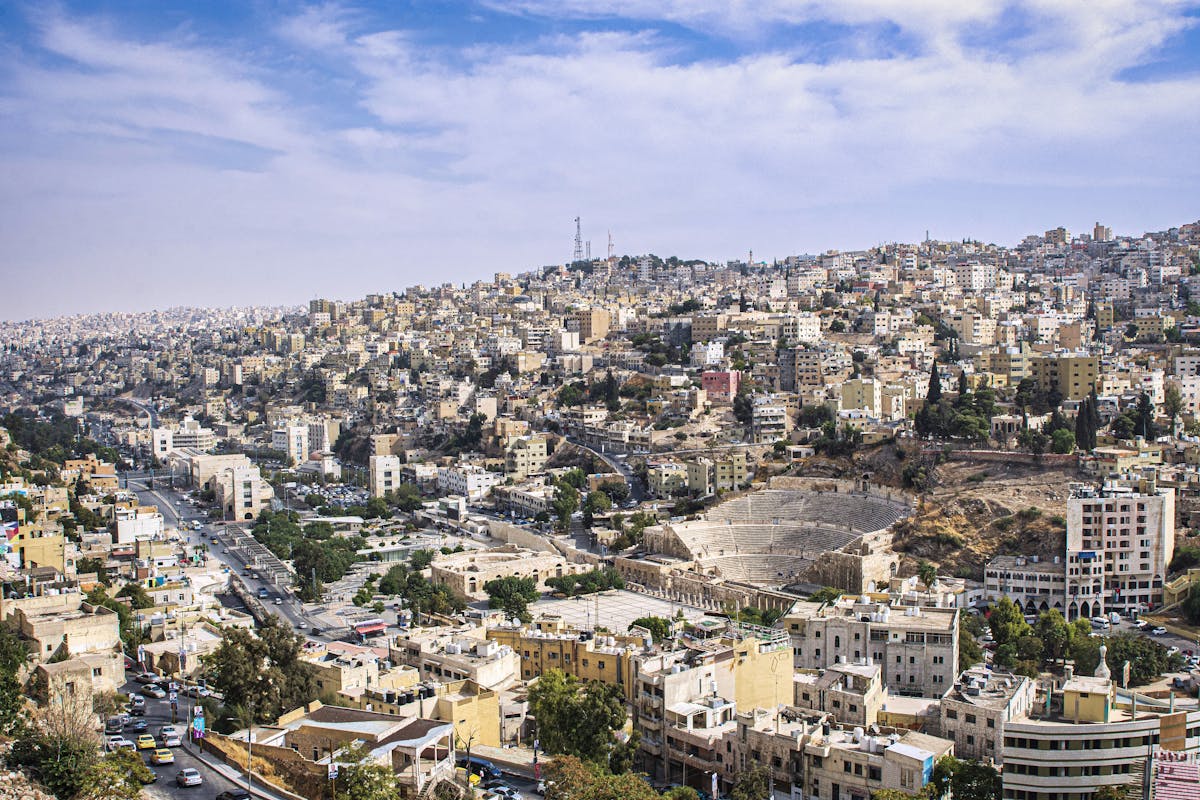
Leisure travellers should look beyond the capital. The Citadel, Rainbow Street and downtown can be combined in one or two days, while the Dead Sea is roughly an hour by road and can be scheduled directly after landing. Petra is much farther south and works better as part of a multi-day itinerary. When a journey includes Amman, the Dead Sea and Petra, we plan not only the aircraft arrival time but also chauffeur timing, hotel check-in, daylight and the pace you want on the ground.
Spring and autumn are often attractive for leisure travel because temperatures are milder. Summer can be very hot, making the timing of transfers and outdoor activities more important. Business demand is less seasonal, although Ramadan, public holidays and major regional events can affect local working hours and availability. A private jet provides flexibility, but that flexibility works best when permits and local handling are planned to the same standard.
From landing permit to return flight: one plan for the entire mission
For Amman, we prefer to receive the full trip structure from the outset: one-way or return, preferred timings, passengers, nationalities where operationally required, baggage and the actual final address. That allows us to assess permit, handler, aircraft duty and ground transfer together. For a short business stay the same aircraft may wait, while for two or three nights a drop-and-go structure is often more efficient. We then compare parking and crew-stay costs with repositioning a suitable aircraft for the return.
The departure airport in the Netherlands or Belgium can also change the commercial picture. On an almost five-hour sector, an aircraft already in Rotterdam, Amsterdam, Brussels, Antwerp or Düsseldorf may produce a meaningful difference. If your home address allows flexibility, we compare these starting points as well. The objective is not simply the lowest bare flight price, but the best combination of total journey time, aircraft quality, conditions and operational reliability.
Any price indication shown on the destination page is read exclusively from the pre-built Destination Pricing snapshot. The page performs no live calculation. An estimate can only appear when enough comparable historical data exists within the same aircraft category. For Amman, the current quotation remains decisive because permits, positioning, season and aircraft availability can have a relatively large impact on a longer international sector.